Book EN

The basic unit of the Maasai nation is one Maasai man or one Maasai woman. A typical Maasai has a physique that is as if some giant grabbed him by the legs and head and stretched him slightly upwards. He is slender and tall for the local conditions. He’s also identifiable by the fact that if he remains silent or doesn’t spot a cow for an hour, he plunges into deep sadness.

Ndari, too, is one of the fundamental units of the Maasai nation.

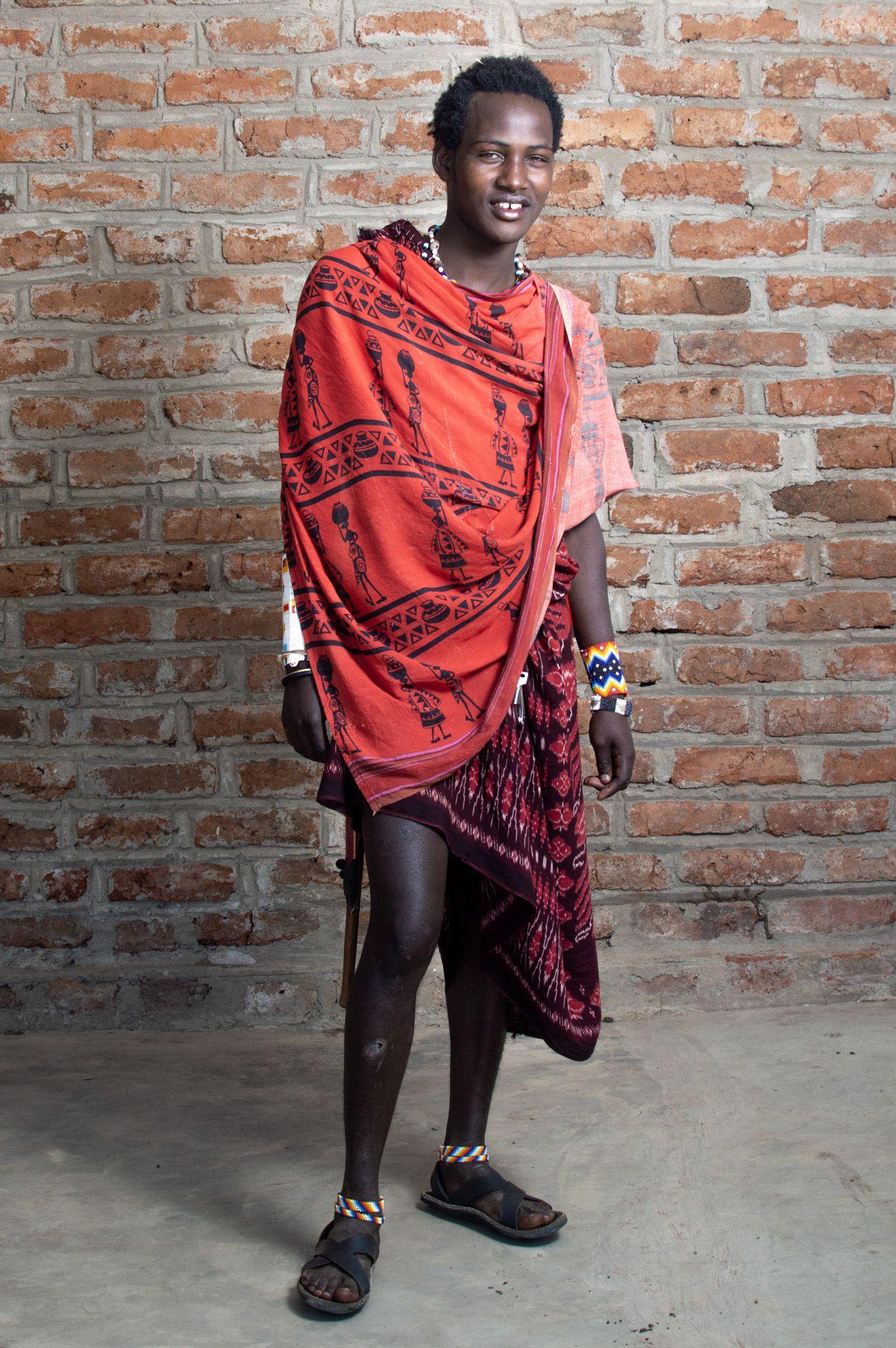
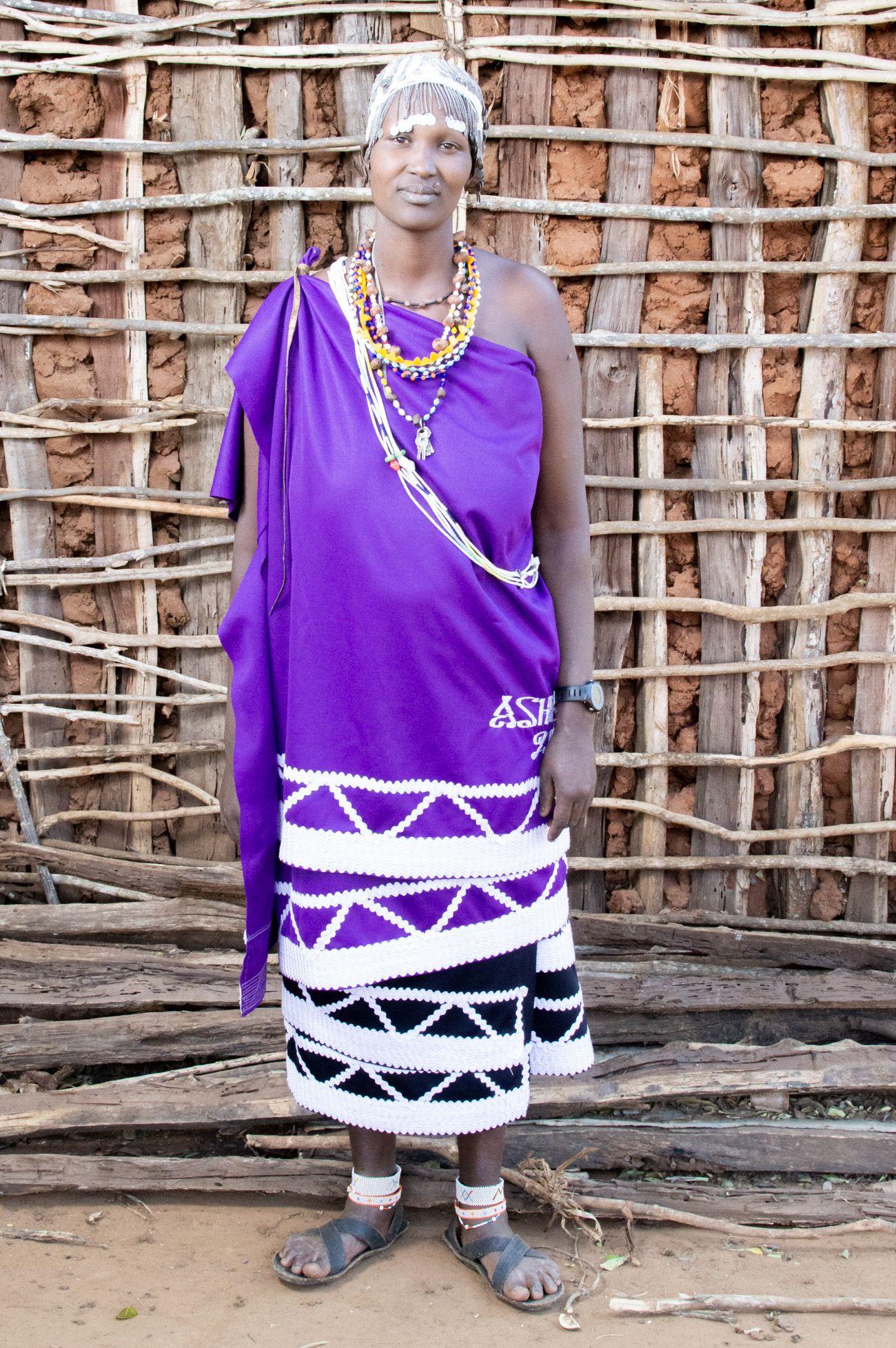
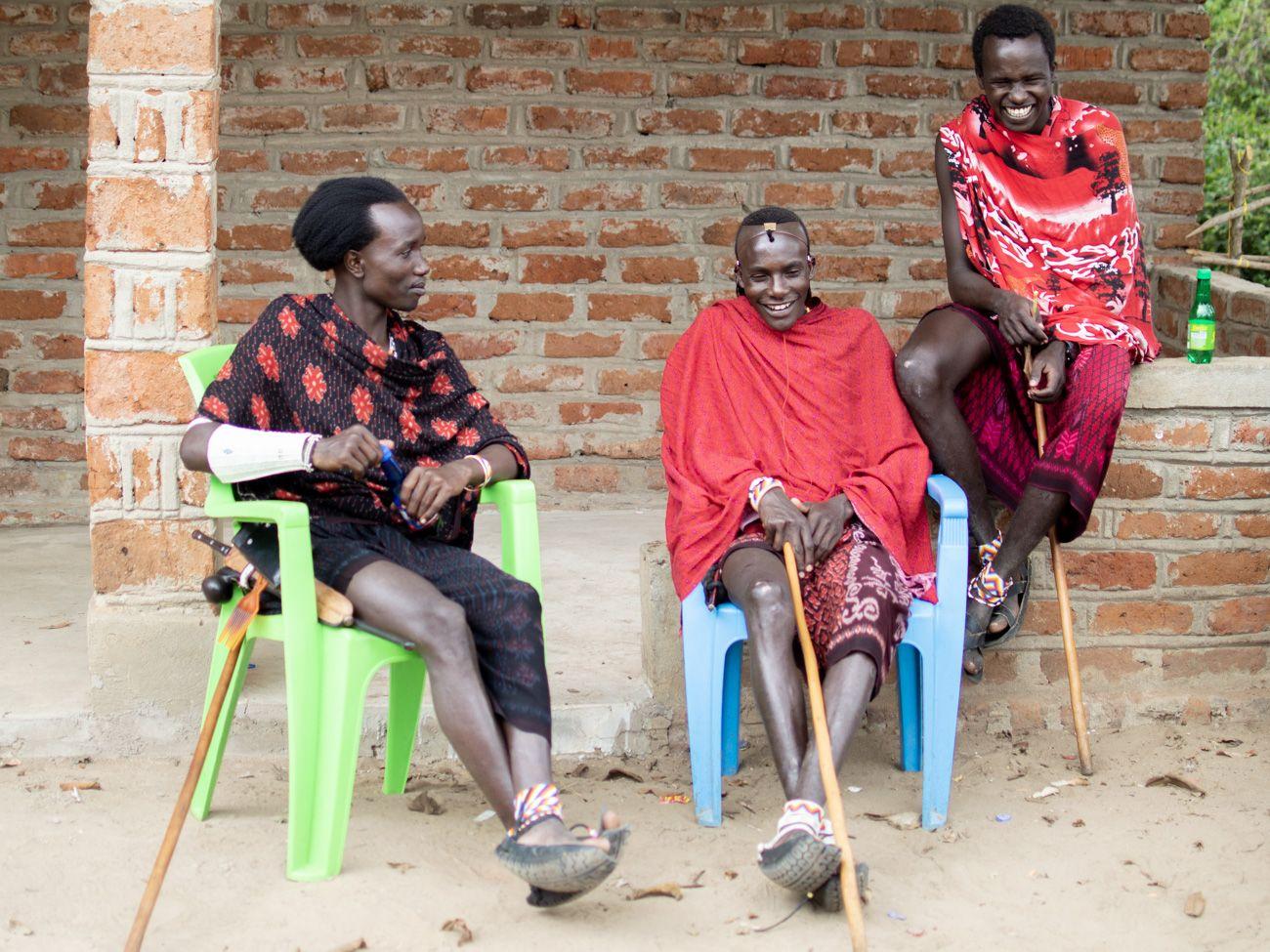
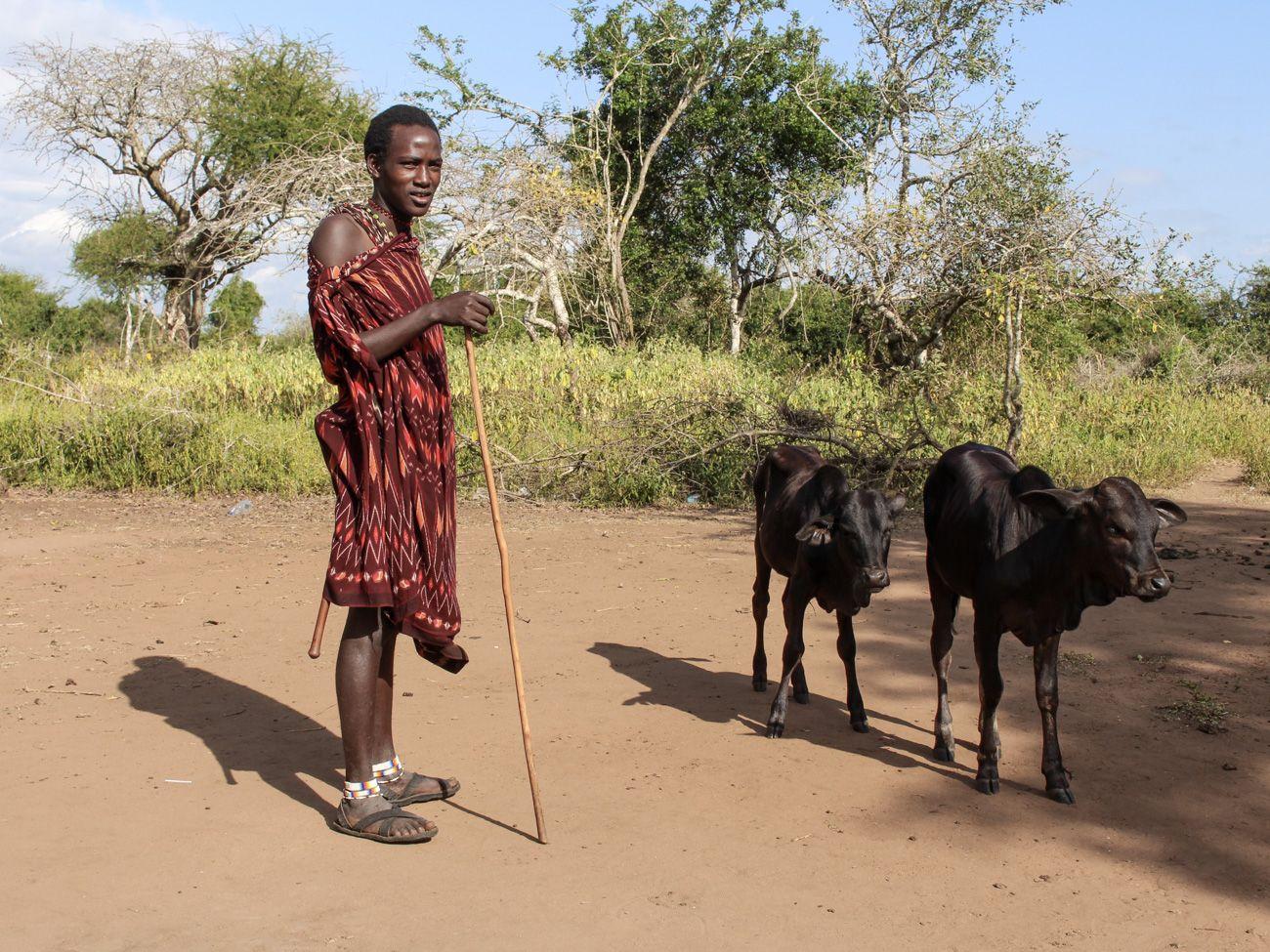
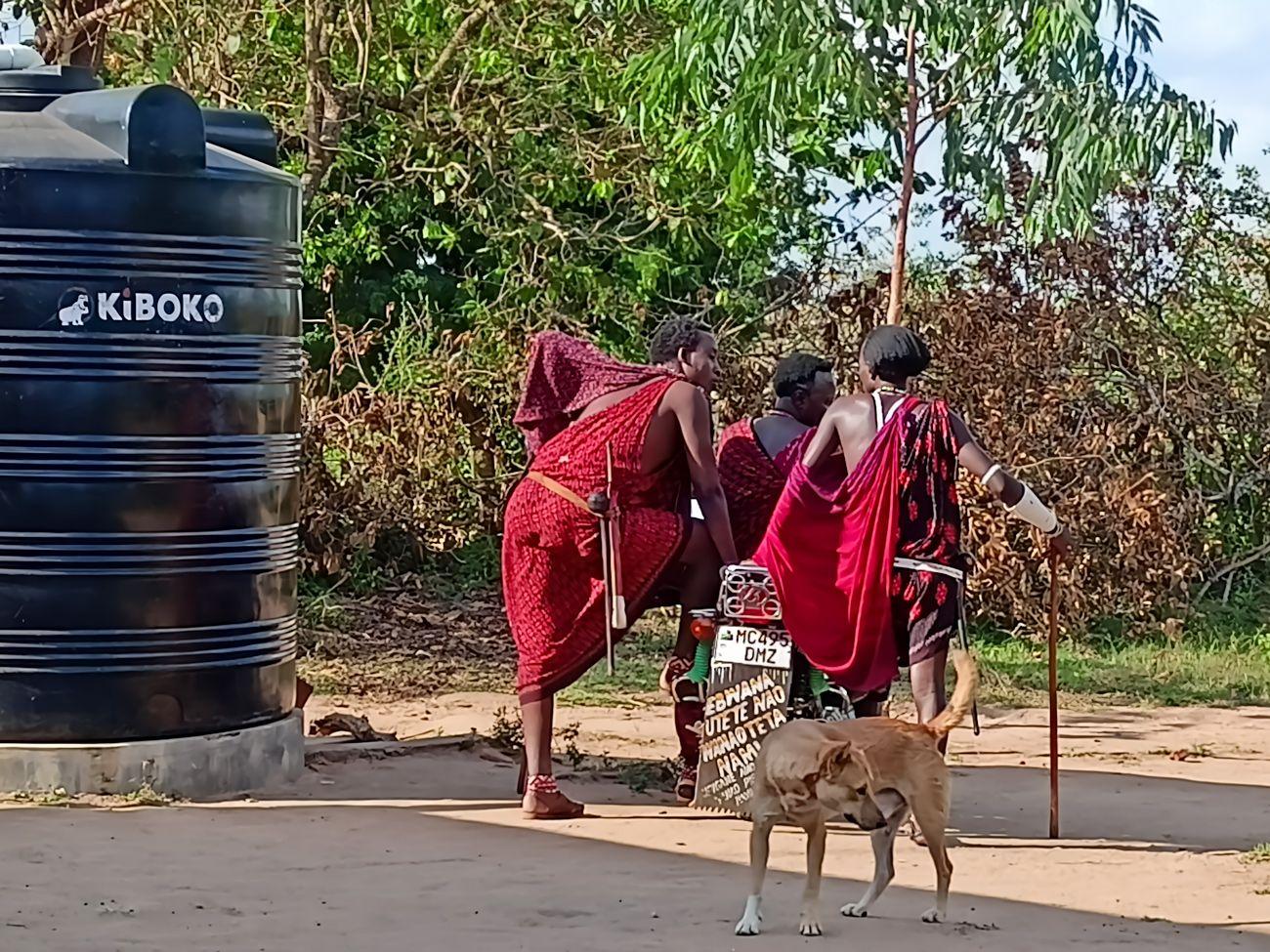
The Maasai dress simply and uniformly. Men's attire consists of two cloths: one sewn into a long tube, while the other is casually draped over the body. Women typically wear one-piece dresses made of purple synthetic material, all in the same cut, color, and, as I observed, likely the same size.An integral part of a Maasai’s outfit is their weaponry, which they strap on in the morning and carry throughout the day. This includes a short machete or a longer knife (which, as far as I can tell, are pretty much the same thing) and a wooden hammer called a rungu. These weapons are incredibly practical when a Maasai is wandering around the house—they can be used to knock anything within reach off the table.

The Maasai uniform also features shoes made from old tires. In many photos, they’re wearing yellow or white sandals. However, those are ceremonial footwear reserved for special occasions. Since most pictures are taken at such events, the Maasai are often seen wearing different sandals than the ones made from tires. Naturally, some “show-offs” wear these fancy shoes even outside of ceremonies, though it’s a rare sight. Maasai men’s clothing is usually red, but I’ve seen designs in blue and green too, from plain hues to giraffe motifs.

Roda.

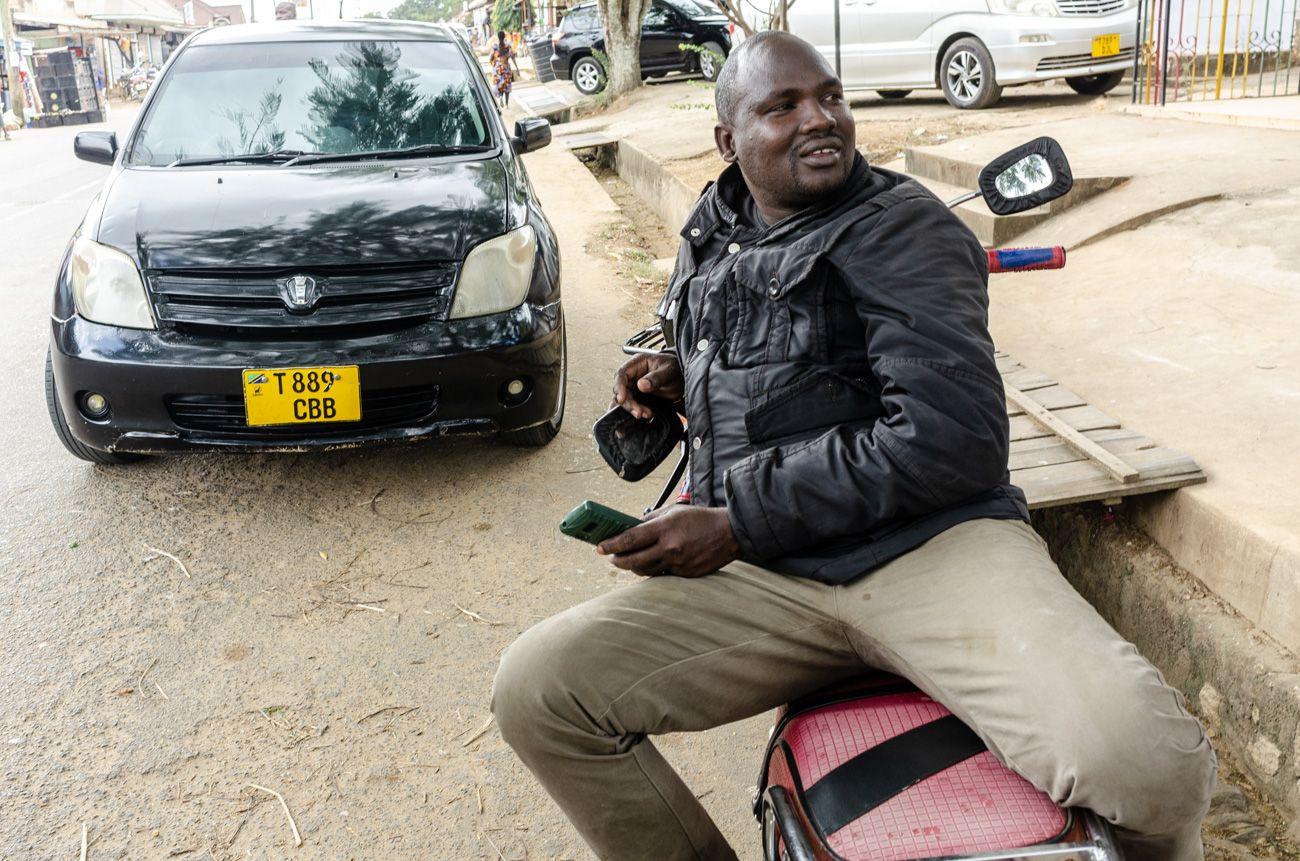
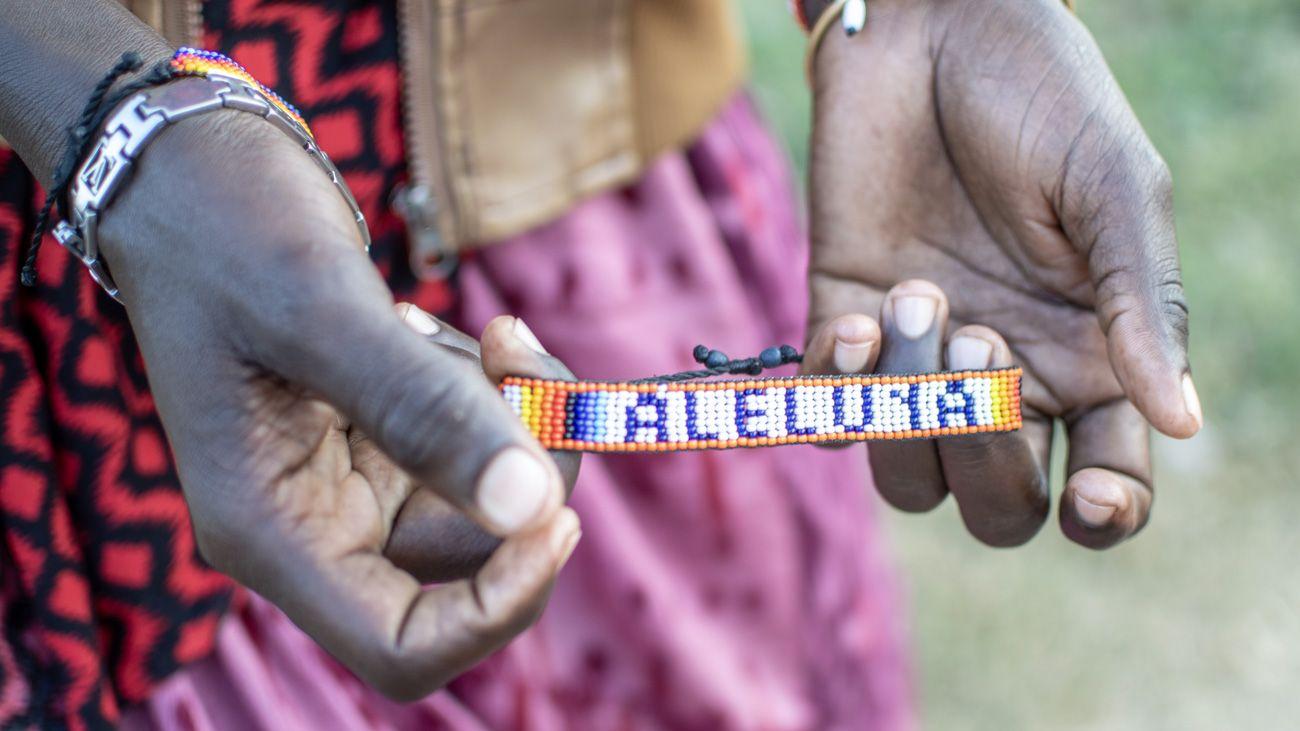
Beaded necklaces and bracelets are an essential part of Maasai attire for both men and women. Here, Kojkaj is the only Maasai who wears pants on a regular basis, as he’s busy fixing motorbikes for everyone.
Once, even my friend Alojz decided to wear pants. When I saw him in them, I joked that he finally looked like a proper human being. I said it in English, but Alojz, unless he’s had a few deciliters of cognac, doesn’t understand English. That was fine, as our host Maasai, Sekenoi, took ten minutes to explain it, and we all laughed for at least ten more.

When Alojz puts on pants, he actually looks like a person.

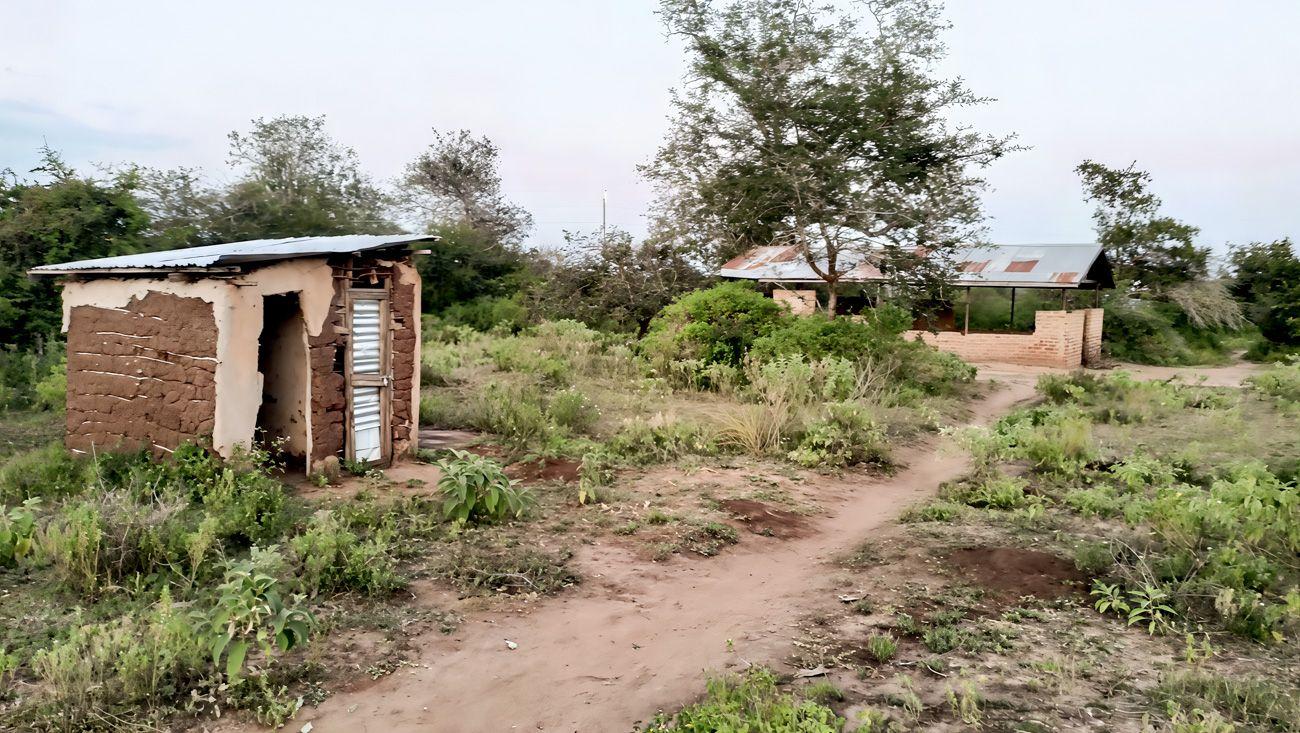
Tanzania is predominantly a Muslim country, though there are many Christians as well. The Maasai aren’t particularly fond of Islam. Apparently, in Handeni, a nearby city, there’s one Maasai who is a Muslim, but he lives alone because no one likes him due to his faith. In Mbogoi, however, there were many Christians. It was said there were two churches, but I only spotted one, near the house I stayed in. During our endless evening talks over beer, we also discussed this topic. My black friends joked that the Christian God is amazing—you have no idea who he is, but he promises you whatever you want.

A Christian church in the background, with a decidedly non-Christian toilet up front.

The Maasai have their own beliefs. They believe that the sun is the father and the moon is the mother. They believe in the evil eye, but no supernatural abstract religion has reached them yet. It’s kind of entertaining. I asked them about the tales mothers tell their little ones. They don’t have any favorite stories. Mothers make them up on the spot. The tales are based on things they can imagine—like a goat meeting a leopard. There are no flying horses or other fantastical creatures.
This leads to weaker abstract thinking among the Maasai. They struggle with math because numbers are inherently abstract. They can calculate that if one beer costs 1,000 shillings and another beer also costs 1,000 shillings, together they cost 2,000 shillings. But the question of what 1,000 plus 1,000 equals is an unsolvable puzzle for them.

The Christian God is amazing—He promises you whatever you want.

A Maasai who isn’t standing in a group, chatting, or listening intently feels like only half a Maasai to me. It’s as if he’s suddenly thirty centimeters shorter and ten kilos lighter. I believe that just as breatharians are said to survive on air, Maasai live off constant conversation. They can spend a week, ten hours each day, discussing problems we’d consider simple. I imagine they even talk in their sleep. If Maasai ever have a parliament, their discussions on the first agenda item might not end before the sun itself goes out. I have a funny story about this. We were at the playground to make some calls. Renča was phoning home, handling something online, and Sekenoi was on a call too. After about thirty minutes, Sekenoi finished his call, came over to me, and noticed that Renča was still talking.
He asked me, “What on earth do women talk about for that long?”
I couldn’t help myself and asked what he had been talking about and with whom. He revealed that he’d called some relatives and a Maasai who had just returned from Kenya.
So I asked him to share a story. What did he do there? How did he come back? Just anything. “To be honest, I don’t know. We didn’t have time for that,” Sekenoi replied.

One more mystery of the universe, resolved with success.

I almost forgot about the indispensable part of a Maasai’s life—the staff called mudi. For every Maasai, it’s practically a third leg, and no, I don’t mean that in any suggestive way. It’s more like a loyal companion, akin to a dog. A mudi is something the Maasai always have close at hand. I’m even convinced they sleep with them, although I’ve never seen a Maasai sleep directly in a boma. I imagine them placing their mudi next to them at night, then arranging the other mudi belonging to family members. Perhaps the whole family even sings them a lullaby. The mudi truly proves to be an excellent “third leg” in practice.Maasai lean on it while walking, especially during long hours of standing. It’s almost always in action.

The three-legged, mudi-stabilized Ndari.
Share this

The reason this content is locked isn't that we were after money, but because we locked it and lost the keys. Your Maasai.

Share this

You need a permit from Munikiti to build a house in the village. The other day, he got all riled up because someone had built a house there without his knowledge. I started wondering what it might look like if you wanted to build a house out in the bush. Whose permission would you need?
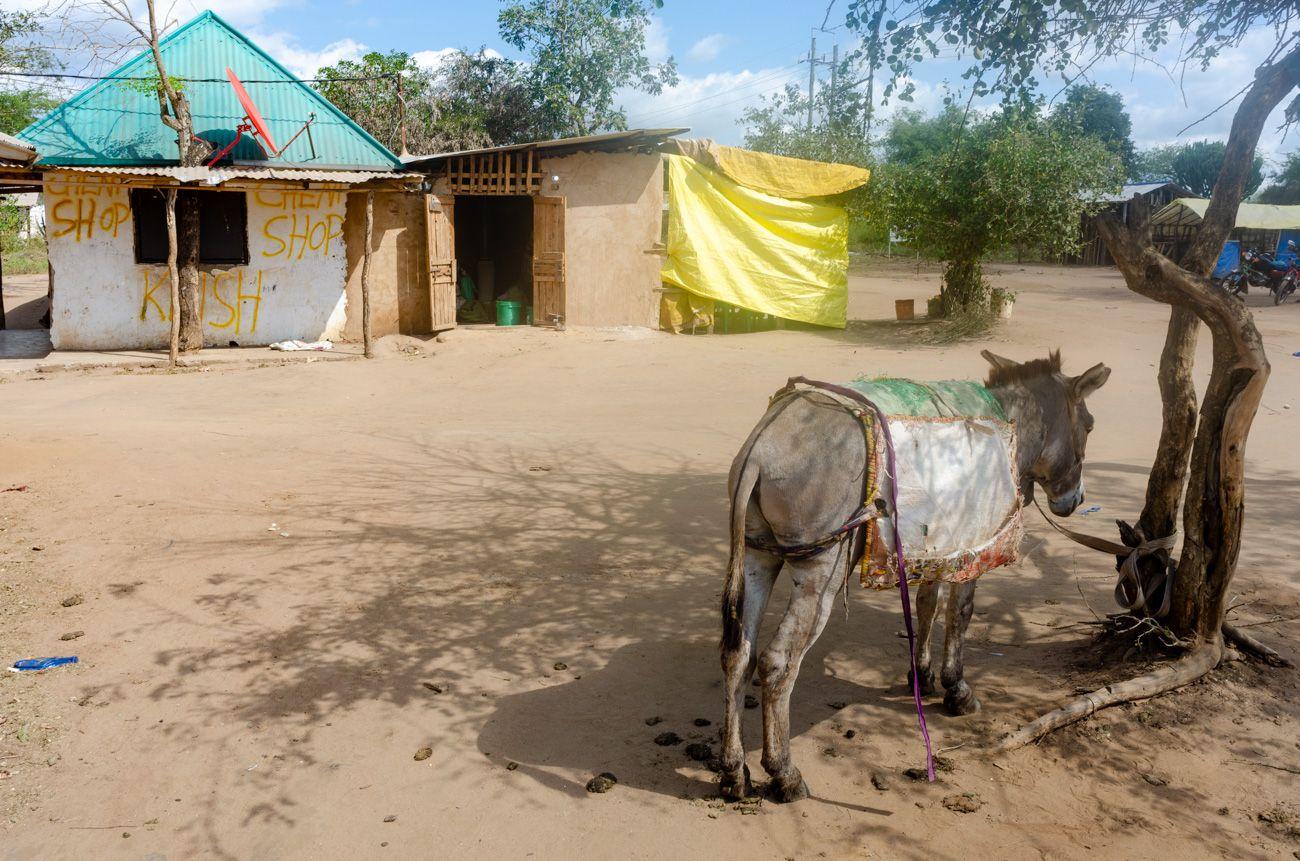
You’d probably have to pay a visit to the nearest leopard. It would either eat you alive or hand over the permit—just like our bureaucrats back home. Village houses, though similar at a glance, come in a whole variety of styles. It depends on who built them, which tribe they hail from, and what building methods they favor. You’ll see some with plaster, some without, some crooked, some even more crooked, made of fired bricks or unfired ones—some reinforced with wood, some not at all. Roofs can be made of metal sheets, tarps, or just shrubs—basically whatever’s handy.

Proper men own motorcycles or donkeys.

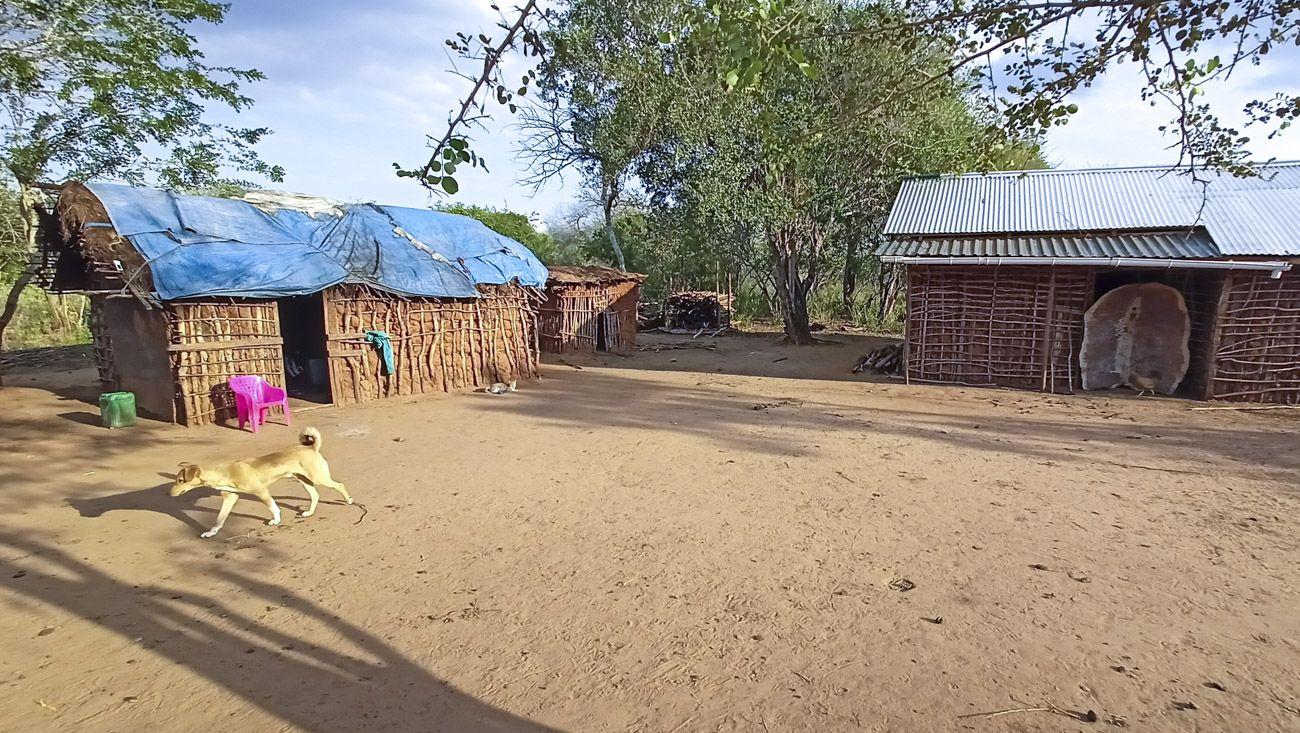
Traditional Maasai houses in a boma (a homestead typically consisting of a few family huts plus enclosures for cows and goats) look a bit different. They start by setting up a frame made from what they call “thicker” trees—though in their case, “thicker” means trunks about 5 centimeters in diameter. Then they weave thinner shrubs horizontally through these upright posts, creating a kind of basket. Into that “basket,” they toss some mud, and presto, the house is complete. They end up with a sort of woven basket, pack it with mud, and voilà—instant home. The roof is made of shrubbery but covered with a thick plastic tarp—something like the canvas used on cargo trucks.

Boma.

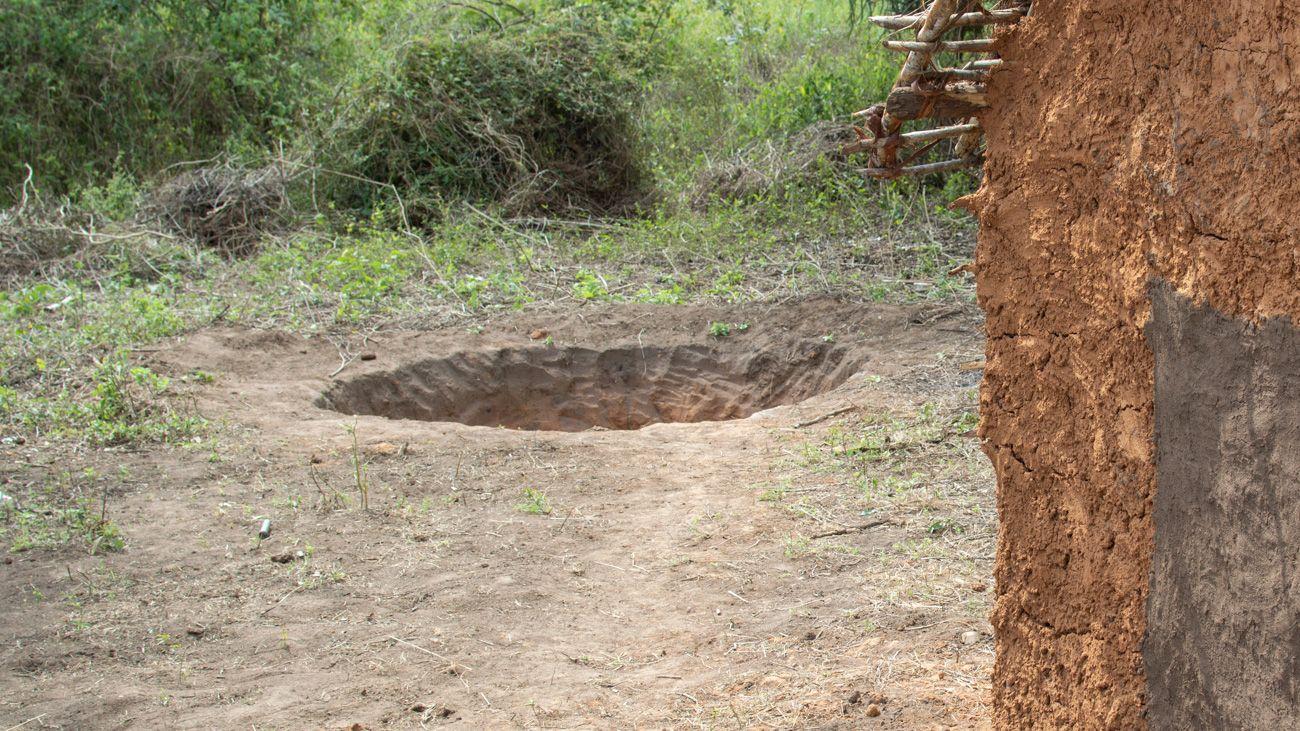
Behind every house, there was a pit stocked with material for fixing the place up. The surrounding soil was sandy, but once they dug down, they found a layer of rich, clay-like earth. If part of the house fell off, they simply jumped into the pit—only about three meters away—scooped up some clay, and patched whatever was damaged. Things got interesting when the beams finally failed, sending the entire home toppling over—but honestly, nobody seemed to mind. Building such a house took a single person about a month, and they still managed to herd cows and handle other chores in between. If multiple folks teamed up, the house could be done in just a few days.

A typical Maasai house has no windows. It has only a small opening, something you might call a firing slit. I can’t tell if they shoot arrows through it, hurl spears, or just fling filthy looks at the great outdoors. Inside, there’s a single room. Two beds along the sides sleep everyone. There’s also a shelf with pots and a handful of basic tools. At the end of the short hallway are the water containers. That’s practically the entire property of a Maasai family—besides their cows, of course. In the boma, I also spotted a small hut used to store corn and whatever else they don’t currently need. By that, I mean everything except the pots, water containers, a motorbike, a phone, and their cows.

Source of construction materials.

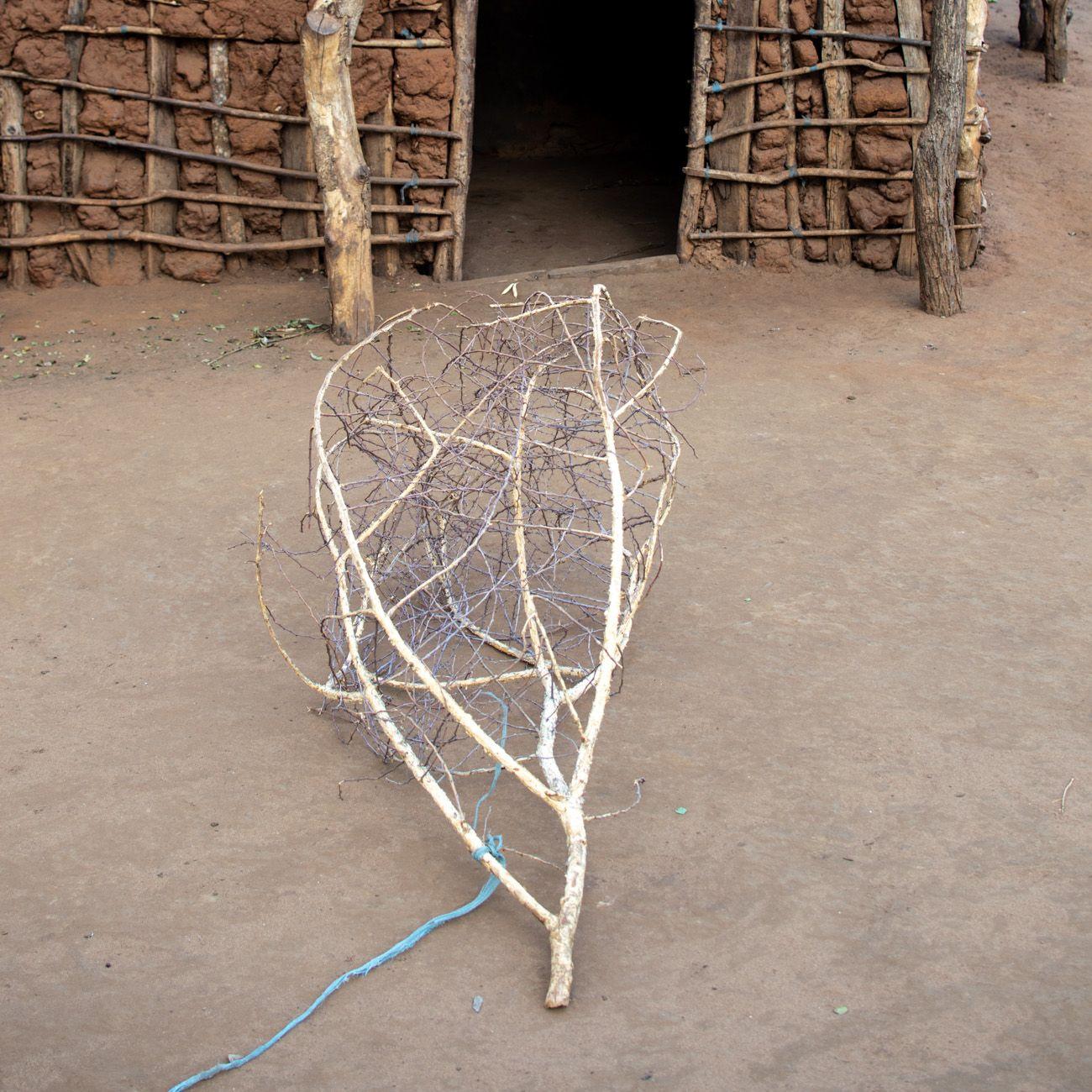
Some houses had plaster and cheerful lettering. Others had none at all and gave off a temporary vibe. In the old days, all houses were temporary anyway, because the Maasai frequently roamed with their cows in search of fresh pastures, tearing down their homes and rebuilding them over and over. The doors were quite a spectacle. They stayed wide open all day—what with women and kids constantly passing through—but in reality, they weren’t doors at all. The more traditional option was simply a strip of dried cowhide. The top prize for door creativity goes to the acacia shrub molded into a squash-racket shape. Lean this “racket” over the opening, and you’ve got yourself an instant door. 

Doors that require manual opening and closing, known as manual doors.

Some of the wealthier folks in the village built their houses with fired bricks. A few of these bricks were only fired at the bottom—so the water wouldn’t wash them away—while the top half remained unfired. Ali, who lived on Renča’s land, made bricks himself. He built his own place and also built one for her. Since his wife worked as a cook in a local restaurant, they often hung around there.
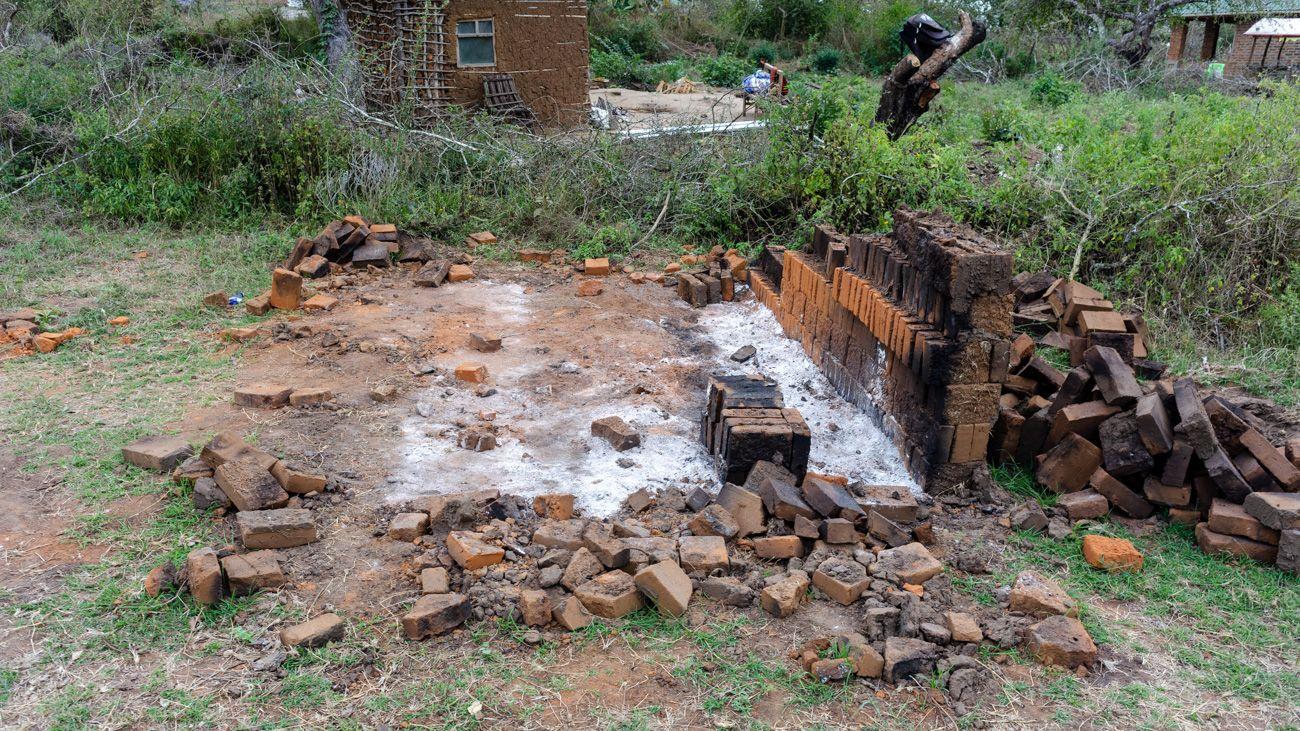
That meant I had plenty of chances to snap pictures of how people fire bricks at home in Africa, but there simply wasn’t time. I was so acclimatized that I just had to sit around, stand about, and chat. It never really worked out, but I did manage one shy snapshot of the furnace where they fired the bricks. They actually build the kiln using unfired bricks. A fire is lit inside, firing the bricks, and then the whole kiln gets dismantled. Sure, these bricks crumble a bit—brush against a wall and you’ll end up with dusty clothes—but in principle, they withstand the rain and don’t dissolve like the unfired kind. They might shed a little dust—lean on a wall and you’ll look like you’ve wrestled a chalkboard—but at least the rain won’t reduce them to mush like the unfired variety. 

Besides the brick kiln, I also recommend a point of interest in the background—Ali's house has a window.

One peculiar category of buildings in the village bore a passing resemblance to prefab garages. They were, however, built of bricks and always sat on a raised platform to protect them from rainwater. Sometimes there were several of them side by side in a single block—five, four, or three units—but occasionally there’d be just one standing all by its lonesome.

Garages, apartments, shops, workshops, Swahili people – all rolled into one.

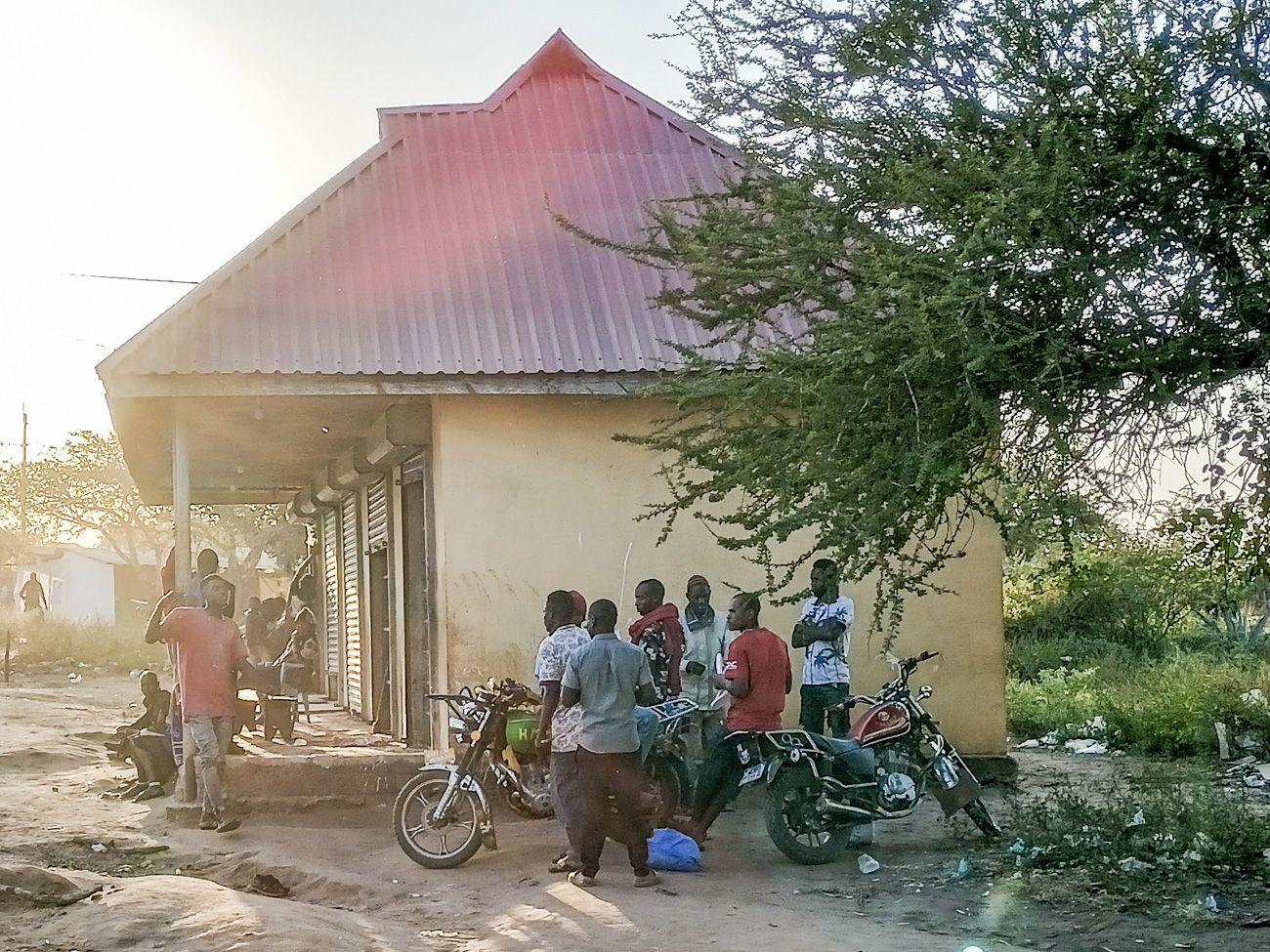
They couldn’t really function as garages, if only because cars rolled into Mbogoi about as often as cell signals did—and then there was that raised floor. These “garages” generally served as rental spaces for shops or street food stalls. If someone decided to rent one as a place to live, that worked too. Close to our house, Swahili folks lived in a double-garage setup. During the week, they were hardly around, but come the weekend, they made full use of their “garage.” These structures add a unique Mbogoi vibe—complete with idly loitering Maasai looking on.

Share this

One time, we decided to walk to the market in the neighboring village because on Thursday, we had forgotten to buy something, and the Sunday market in Ndukai, about 7 kilometers away, was our last chance. The road was rough and riddled with potholes. Just then, an old truck loaded with vendors and their goods overtook us.The truck tilted now and then, as if it might tip over at any moment, but the driver seemed utterly unconcerned. As they passed me, the driver leaned out of the cab and shouted down at me: “Mzungu, Bara-Bara!” In translation, it means, “White man, road!” The unmistakable look of blame in his eyes was hard to overlook. It was immediately clear to me what he meant—that I should fix the road or at least pay for its repair.

Fuso, the truck, appears to be hunting for a 90-degree angle with the road.

The funny part was that the truck bed was carrying about fifteen people and several shovels. Those shovels were probably there to help dig the truck out if it got stuck in one of the potholes. In reality, this crew could repair the road in about two hours—but it seems they’re waiting for some “mzungu” to pay for it. In my mind, I saw the European version: an African leisurely walking down a rugged, broken road. Next to him, a truck would be driving, with the driver shouting: “Hey, Black man, fix that road!” It sounds absurd, but that’s exactly how I felt.

The road to the Bondeni watering hole.

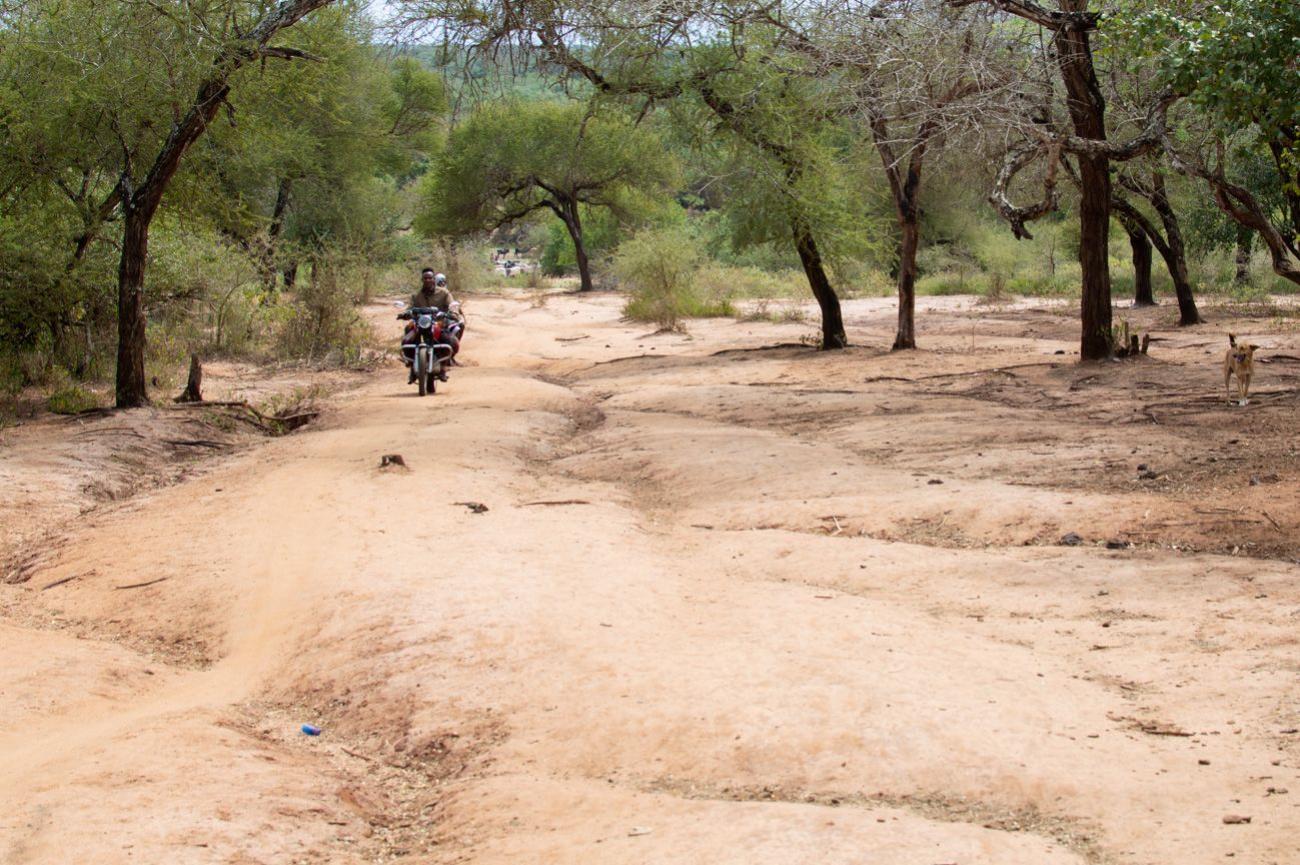
There were many roads in the area—from the tiniest paths meant only for goats and Maasai walking hunched over, to trails for cows, people, and motorcycles, and finally to roads that were suitable for cars.
In our country, no one would let pedestrians on a road like this—especially given the heavy rains that dig deep gullies into the sloping surface. It’s evident from the fact that along roads with trenches, you’ll see massive cacti and trees that don’t grow anywhere else in the bush. These plants can store water when it flows around them and survive the entire dry season. The trenches beside the road are so deep they could serve as trenches in a war between someone and the bush. Who would possibly launch an attack from the bush? Furious ostriches, perhaps? 

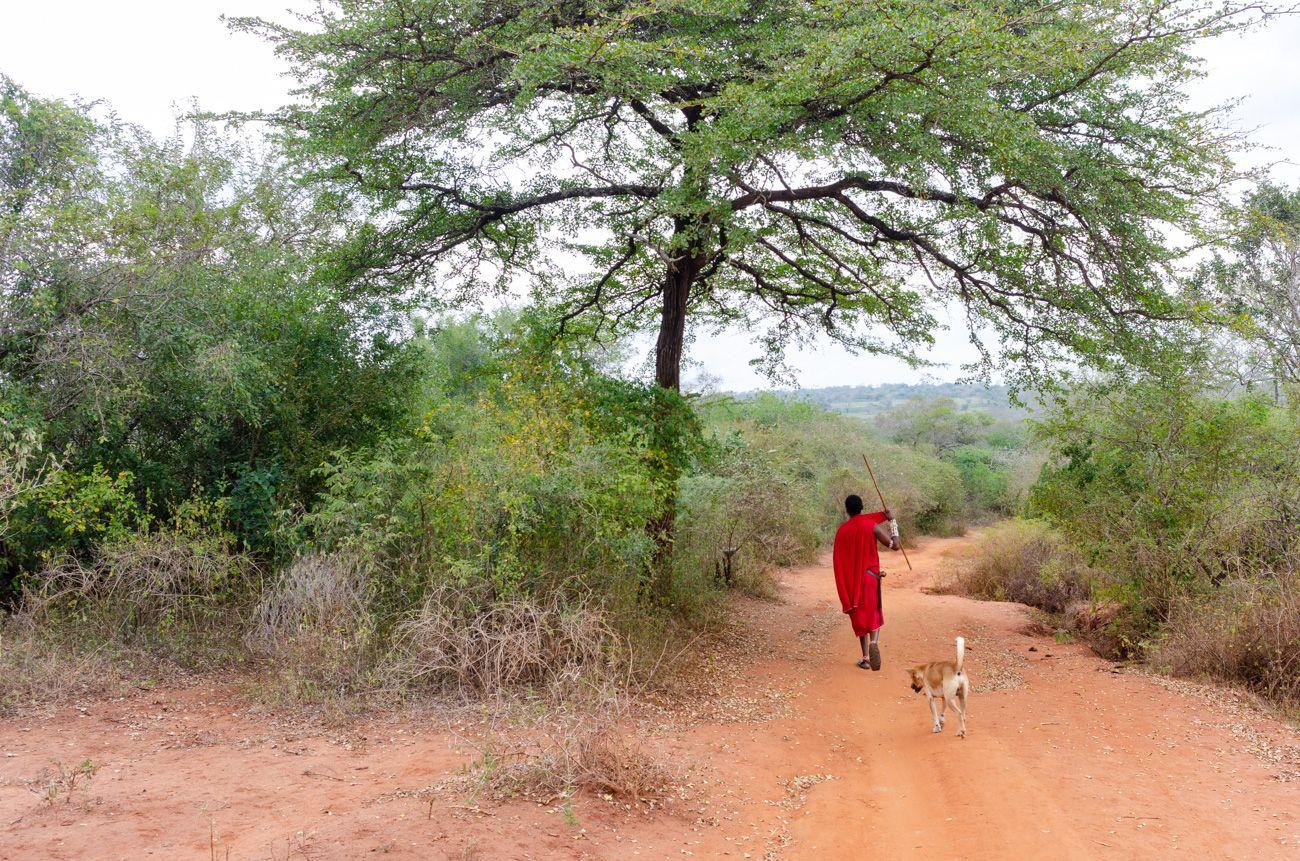
A dog named Labko and a Maasai fellow named Sekenoi. I suspect that after six beers, both of them might start resembling ostriches.

That would be strange, especially since ostriches don’t live in the bush. But there are plenty of strange things there. And I’m still curious about who they’d even fight against. Probably ostriches from the other side of the road. If you ask me, trenches on the road aren’t designed for ostriches—their heads would stick out no matter what. They’re simply not trench-compatible. But enough about ostriches for today.
In Handeni, for example, the nearest bigger town, there are canals nearly a meter deep and about three-quarters of a meter wide. They’re found alongside every road.
While video chatting on WhatsApp, my mom saw the canals and asked if anyone ever falls into them since they’re clearly unsafe.They do. On the bright side, when someone falls in, at least they’re easy to find. Maybe they leave them uncovered on purpose—to make it easier to find whoever fell in. There’s a certain logic to it.

Handeni. Canals on one side, and on the other, a boda-boda caravan prepping for the road to Mbogoi.

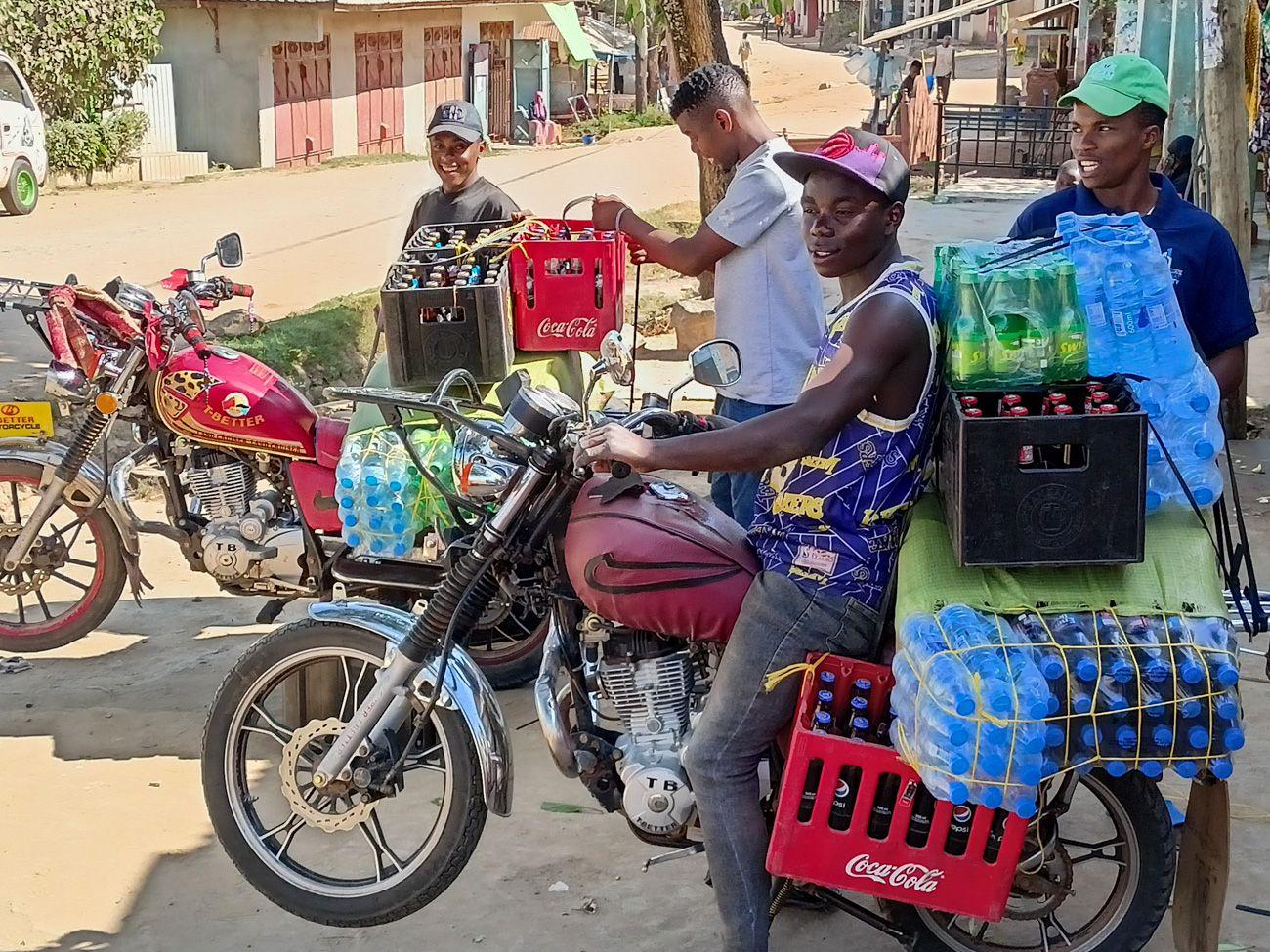
The supreme ruler of Lengusero’s roads is the trusty piki-piki, but it’s got a specialized doppelgänger called the boda-boda. They appear identical, yet the boda-boda is your pay-to-ride cargo carrier. Think of it like the difference between driving your own car and hailing a cab. I’ll keep these two-wheeled wonders brief here, because I plan to give them a thorough spotlight in another chapter. In Lengusere, motorbikes lug around pretty much anything—from refrigerators to supplies for local stores. Sometimes you’ll see one of these contraptions loaded with five people, two colossal sacks of corn, and, perched on top of that precarious tower, one more soul sitting a full meter higher than nature ever intended.
Motorbikes are especially popular because the roads turn into post-rain obstacle courses. A motorbike can gracefully dodge gaping potholes, happy with just the narrowest ribbon of solid ground—just a few dozen centimeters—and off it zooms. Cars, meanwhile, demand a broader, sturdier path. Using a car in this region comes with its own brand of fun. If you’re brave (or foolish) enough to tackle these roads in a regular sedan, you’d better bring along two shovel-wielding companions. And for a truck—fondly called a “Fuso” round these parts—you’ll need a troop of eight. Sure, they can’t save your vehicle if it topples off into the scenery, but if it plunges into a hole the size of a small whale, they can usually dig you back to freedom.

Fully packed boda-boda bikes lined up in front of a drink depot in Handeni.

The longest journey we took on a piki-piki motorbike was the trip to Handeni. It leads to a larger town about 40 kilometers away, with approximately 100,000 residents. Despite that, it looks entirely different from what you might expect.When I got to Mbogoi in early June, half of the road was already wrecked. There was only a narrow, worn track for motorbikes, patches of sand up to 30 centimeters deep, and ditches carved by water along the sides. By the time I left, the road was wide, rolled flat, and perfectly passable.

Steamrollers with Chinese inscriptions, water tankers, and construction crews had arrived in the area and completely repaired the road in just two months. They also completed five out of eight bridges to make the route more convenient. Oddly enough, the bridges aren’t for crossing rivers or valleys. Instead, they’re meant to keep rainwater flowing downhill from washing away the road. The bridges, however, weren’t repaired by the Chinese but by Africans. There were so many of them that, at times, the bridges themselves couldn’t even be seen—they were entirely swarmed by people who looked like they were working.
The speed at which the road and bridges were repaired is actually bad news for the locals. A year ago, electricity was brought to the village, and now they have a new road. Their traditional way of life is slowly but surely coming to an end. 

The road is repaired, but the bridge remains untouched. Everything’s moving because it’s a video.

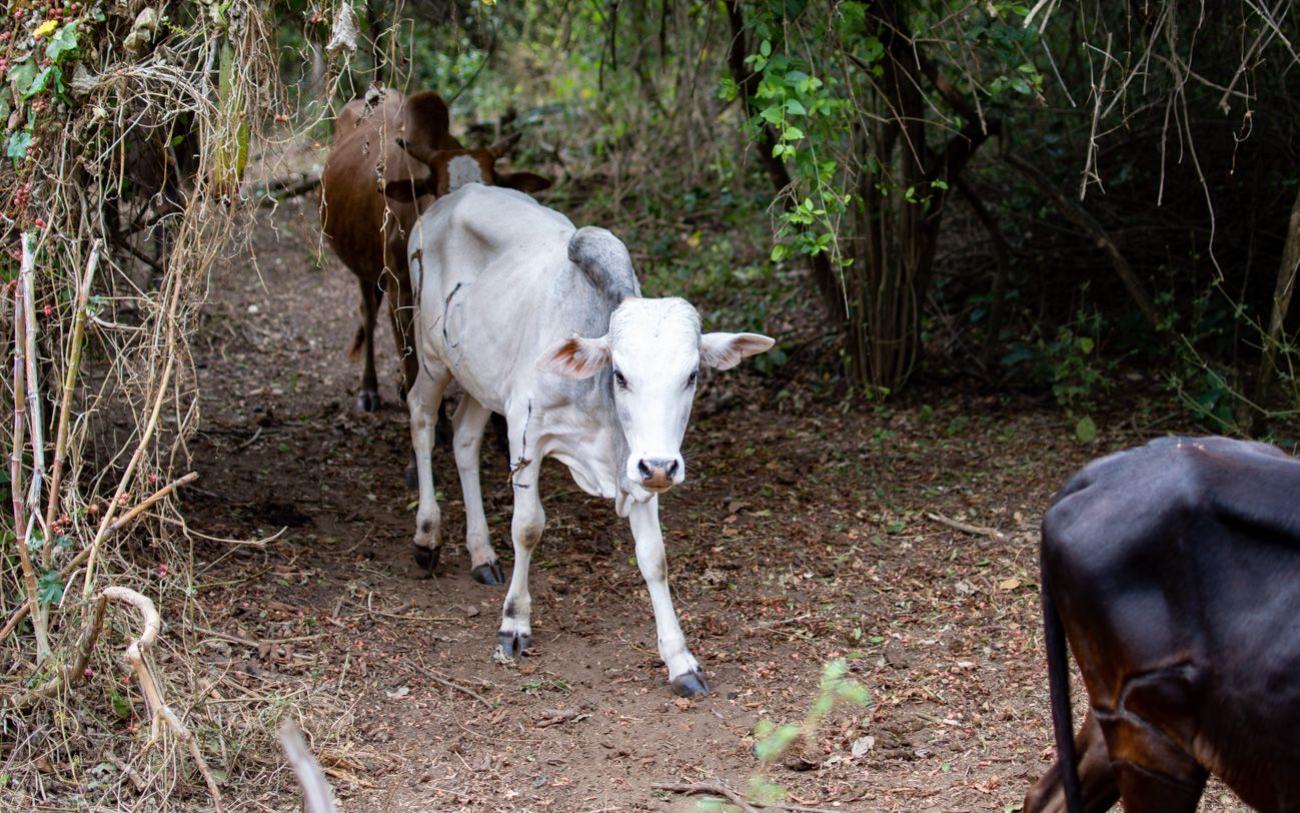
Maintaining the footpaths people walk on is surprisingly simple. If a bush or branch starts to dangerously lean into the path—whether out of curiosity, youthful recklessness, or the dignity of old age—it gets whacked with a stick.If a bush or branch dares encroach on the path—whether driven by curiosity, youthful daring, or the wisdom of age—it’s met with a single decisive strike. Passersby deliver a single, precise hit. Maasai always carry a stick with them—it’s a multipurpose tool for everything from leaning on, to herding cows, to disciplining unruly bushes. Interestingly, each passerby strikes only once.Thanks to this simple yet effective strategy, the paths remain clear—not just for people, but also for cows—and even for the mzungu.

Cows, Maasai, and the occasional Mzungu—free to pass.

I guess by now you’ve realized there are multiple levels of path quality, all naturally formed and each serving its own curious purpose. The funniest footpaths are definitely the ones reserved for cows. They’re roughly a meter high, with shrubs arching overhead, clearly plotting to maim you, shred your clothes, or leave prickly burrs everywhere. Those burrs work their way into anything—boxers, shoes, you name it—and you’ll still be finding them days after your expedition. The Maasai approach is brilliantly straightforward. They stoop to about a right angle and zip through the tunnel in no time. It’s like watching a cartoon, minus the swirling dust. And yes, they’re almost certainly real people, not doodles—though sometimes you do wonder.
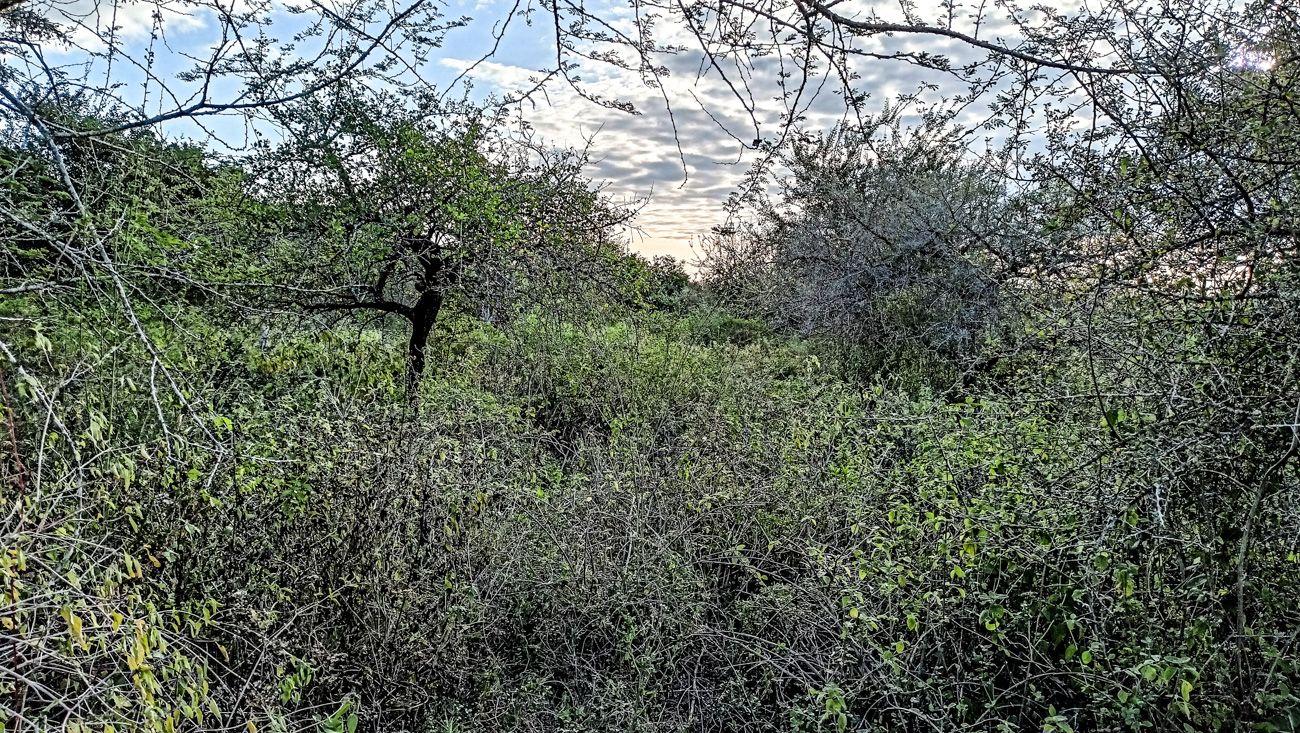
I’ve had it happen more than once while herding cows: falling prey to a special backward-hook bush. Its only ambition is to undress you, lock you down, and pin you right where it caught you. Being the classic mzungu, of course, I couldn’t tell which bush might stab me, which might latch on, and which was simply standing by, entertained by the white guy wrestling the shrubbery. I’m convinced that next to every “grabby” bush waits a carnivorous plant that missed breakfast and is pondering whether I’d make a decent meal. Then again, at least I’d learn if I’m easy to digest.

A pathless bush. Go ahead, try to cross it.
Share this

Coffee exists in many shapes inside the Maasai mind. None of them, however, come even remotely close to anything you’d dare call actual coffee. And yet—Tanzania produces some of the best beans on Earth! As a mildly obsessed home roaster, I decided to take a kilo of green Tanzanian beans home. Home, naturally, meaning back to Tanzania—straight to the source, as if returning a prodigal child to its ancestral soil.

The way they serve coffee here is strange, but it doesn’t hold a candle to the flavor—it tastes like boiled charcoal. It’s not the popular instant coffee, but rather coffee brewed right in a café in Mbogoi.

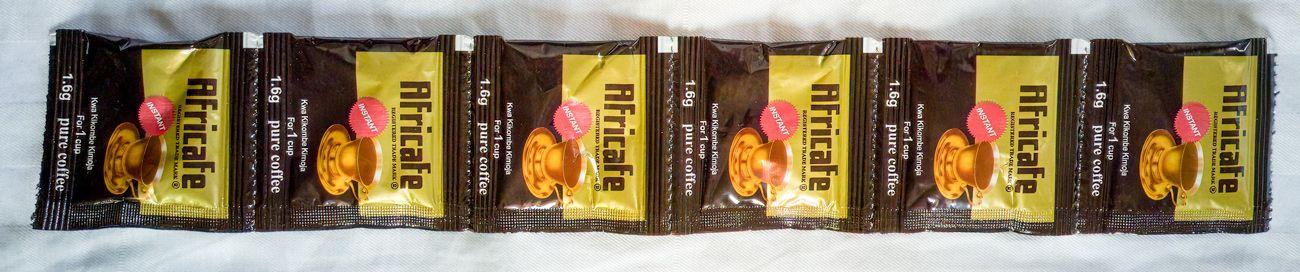
I thought I’d do a big comparison: our imported coffee versus their local coffee. After all, we were just 150 to 200 kilometers away from the regions in Tanzania where this world-famous coffee is grown. I expected to find it everywhere—to see people throwing it around, spreading it over roads, and swimming in giant barrels full of green beans. I imagined homemade roasting techniques and exotic aromas. The reality? They didn’t even know coffee existed, let alone how it tasted or where it came from. The only thing that remotely resembled coffee there was instant coffee. And even that was over-roasted, with a taste further removed from coffee than our cheapest instant alternative. It was usually sold either in cans or in small single-use sachets. Once, we even bought sachets that were completely empty.
And cafés? They’re more of an idea than a real thing in Tanzania. Getting an espresso somewhere? That’s a task for someone with nerves of steel and a lifespan of at least 150 years. So, we solved it in our own way. With Renča and Sekenoi, we drank instant "coffee", over which we poured tea. The tea had cardamom, lemongrass, cinnamon, and somewhere in the distance, a hint of actual tea. If anyone dares to call this coffee, they’d have to have taste buds and brain cells completely out of sync. Since I quite like coffee, in situations like this, I find it helps to convince myself that it’s not actually coffee. And it worked.

Instant coffee? More like coffee-not.

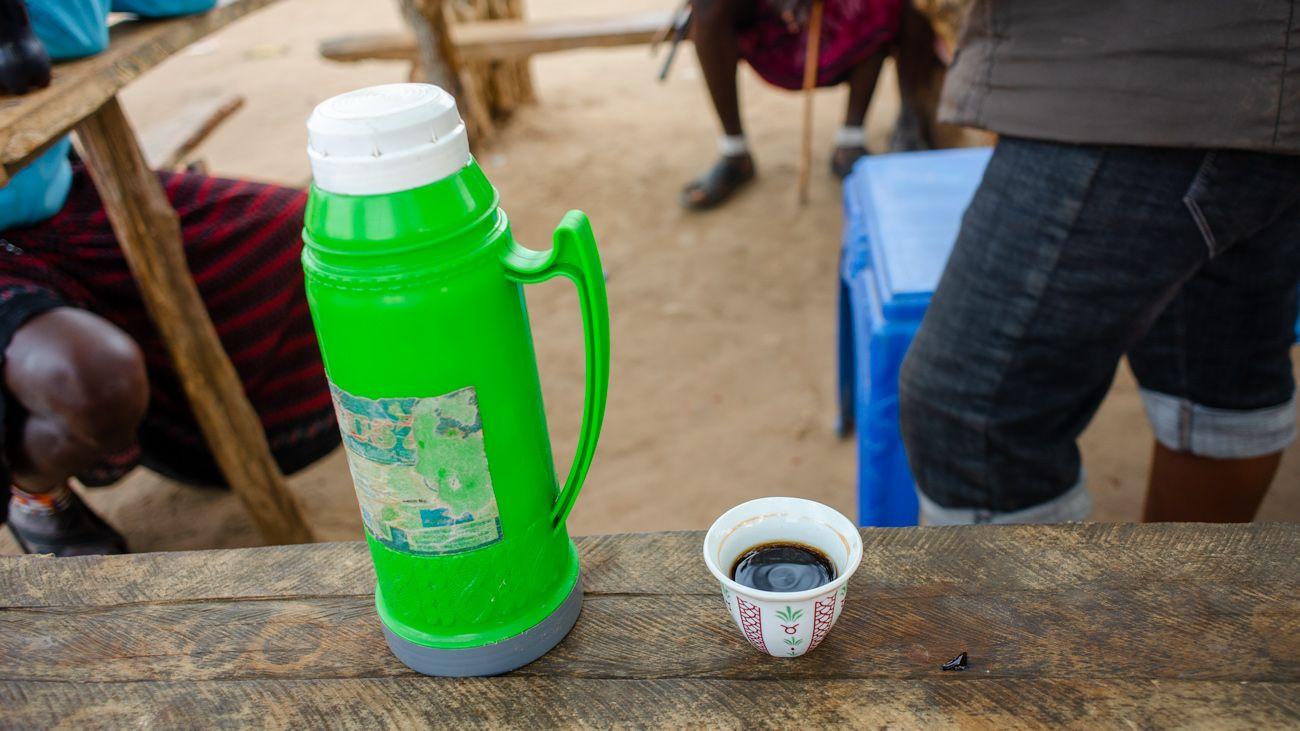
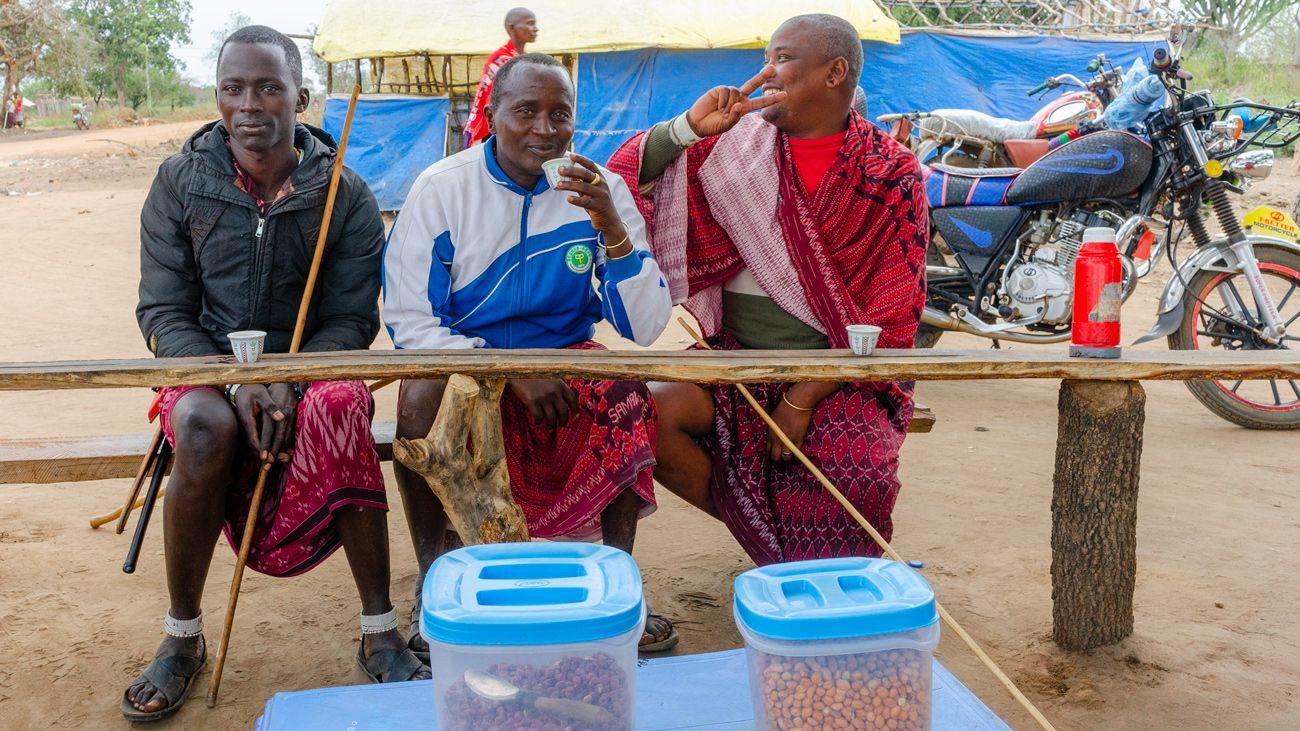
In Mbogoi, among the numerous street food stalls offering the same fare, there was one café. Essentially, it consisted of three narrow tables made from narrow planks, three equally narrow benches, a charcoal stove (djiko), a large aluminum coffee kettle, a few thermoses, and a handful of small glasses.
I was curious about how it all came together and the steps required to set it up. The owner had approached the landowner, as the café was located near the main street, and asked if he could set up a café there. They agreed on a sum, and the rental was settled. Then he procured a few planks and hired a craftsman to turn them into tables and benches—narrow and simple ones. The djiko, charcoal, and his own tea kettle were brought from home or purchased at the market. The café was ready.

What about the health approval, local citizen council clearance, and national committee paperwork? Where are the inspectors checking the proper thickness of tables, the appropriate speed of the staff, the exact height and sturdiness of chairs? Where are the noise level regulators, the food preparation guidelines for astronauts?
What about gender-neutral bathrooms? And where’s the harmony in the color scheme?After all, only Black people come here, and you'd have to transport white folks straight from the North Pole to balance it out. When the officials in charge of all this entertainment finally stand on the street like the Maasai, debating heatedly and staring aimlessly into the distance, I think things here might just start working a little better.

The latest café craze: all it takes is ten planks, and you’re good to go.

When I decided we were going to roast green coffee, the house erupted in joy and celebration. Or, well, I think it went a bit differently—nobody even looked at me, calmly staying seated, so I started explaining what coffee is, why it’s good, why I brought it here, and so on. After a while, the djiko was finally lit, the pot was ready, and Sekenoi and Ndari were thrilled about roasting coffee. They competed over who would stir first.
In minutes everything changed dramatically. The initial excitement turned into severe, chronic limb fatigue combined with incurable depression, and both of them felt an overwhelming and irresistible urge to leave. Both Maasai vanished, and Renča called Mama Penny, who happened to be around, to roast the coffee for us.

Sekenoi and MamaPeny are giving their home-style Maasai coffee roast a rehearsal spin.

So, the coffee is roasted, rested for a few days, and the time has come to brew the beverage with a capital B. I asked the local Maasai—if I remember correctly, it was Sekenoi and Ndari again—whether they’d like some coffee. They leaped to the ceiling in excitement, racing around the house, joyfully yelling: “Hooray, coffee! At last, at last!” Seeing them like this, I joined in, and as the great dancer I am, I performed a few solos from Swan Lake. Since everyone here has sensitive ears, people from the surrounding area heard it too. They gathered en masse around the house, chanting: “Kahawa, Kahawa!” Between my graceful leaps, I shouted back: “You’ll get coffee too, you’ll get coffee! Vivat Kahawa Tanzania!”
Naturally, that was just another story I invented.Their actual reaction was their traditional approach to food they don’t know. Which, apart from ugali, meat, rice, and beans, includes all food. After some intense convincing, they agreed that if they had to, they’d try it, but only a little.

A glorious mental party for my grand coffee premiere, swiftly followed by an AI-led encore. Actual reality? Big fat zero.

Over time, however, they discovered that coffee contains a stimulating substance. When I asked if they’d like some coffee, they all responded enthusiastically and with a smile, “Maybe.” After about two hours of persuasion, they finally said, “Well, if we must, then yes.” They said coffee reminds them of a drink they make when they’re out with the cows for a long time. They call it "medisin" (medicine), and it’s made from various roots they find in the bush. It has effects very similar to coffee, is equally bitter, but tastes entirely different.
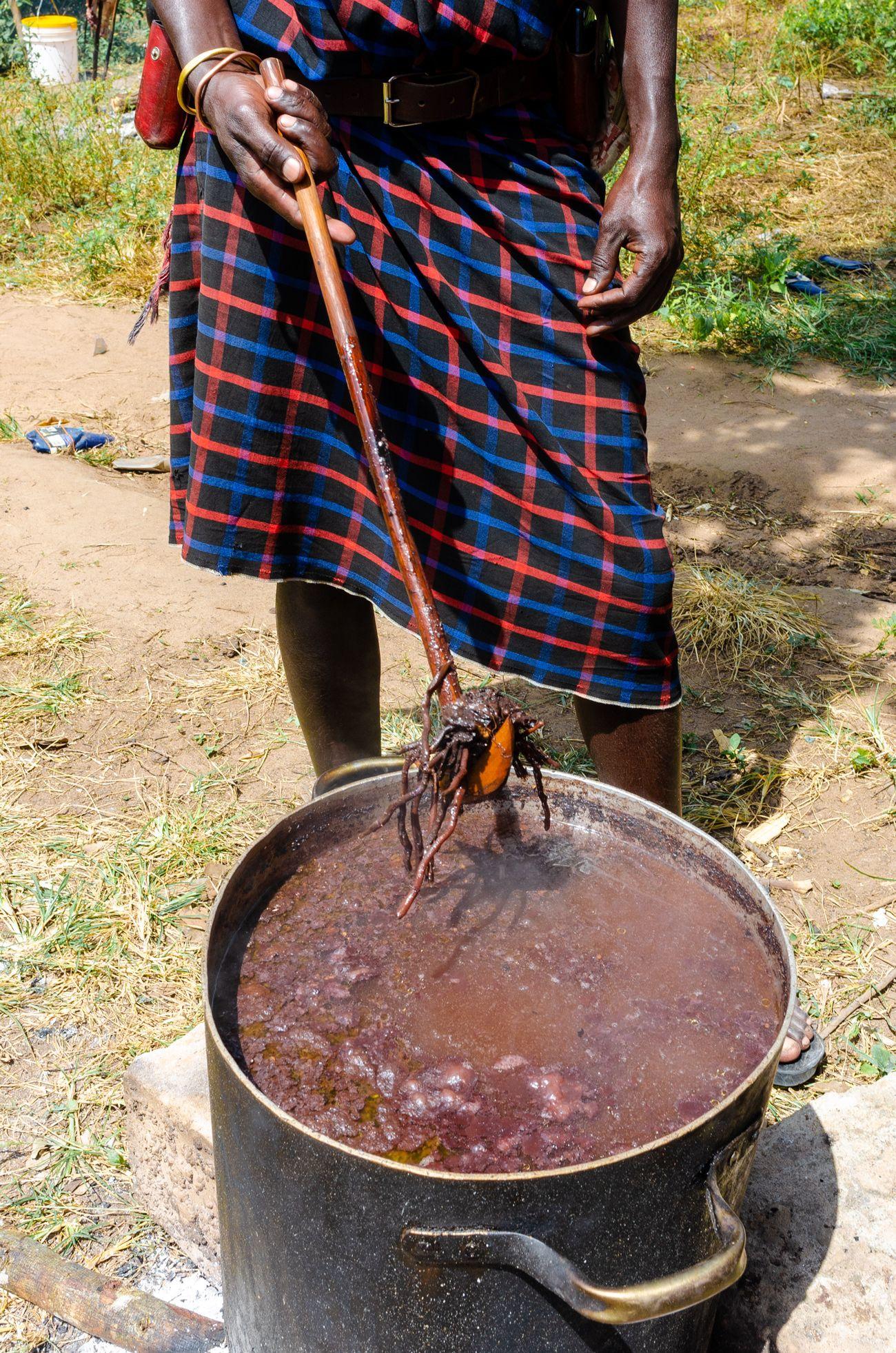
Of course, I couldn’t resist, and at the market, held every Thursday, a local man was brewing "medisin" in a large pot so that vendors and visitors could get a little boost. It reminded me of old engravings of alchemists bent over their bubbling potions. Besides, since the locals aren’t skilled in wood engraving, spotting an alchemist would be nearly impossible. Naturally, I had to try it myself, and as you can see, I’m still alive. It tasted almost like coffee, only it was far from being coffee.

The Maasai Alchemist & “Medisin”

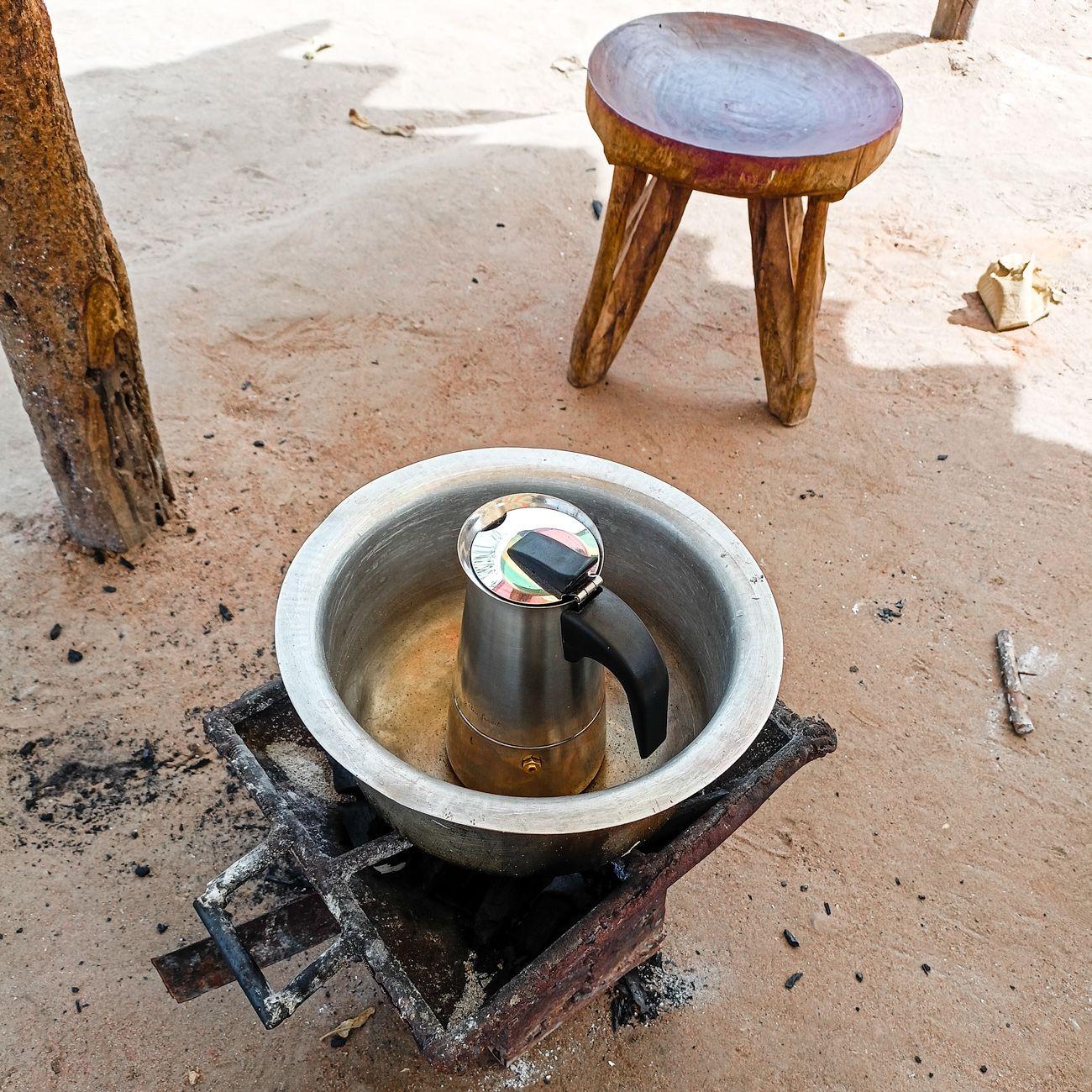
My first attempt at brewing coffee took place in the pre-electric era, back before the double-burner stove entered the house. The epic adventures of starting up the small charcoal stove, known as the djiko, can be found in the section on tea. Life is full of foolish decisions. For example, trying to explain the concept of heat capacity to a local Maasai. Or teaching kids in an African school how to pronounce "endoplasmic reticulum" correctly. I decided to add another crazy idea to the list—explaining to passersby, bystanders, and nearby onlookers how a moka pot works as I brewed coffee. 

The moka pot, thermal capacity, and “endoplasmic reticulum.
Share this

It was a joy to watch how people here mix a random beverage in a mug with such enthusiasm. Stirring sugar into tea, however, is no simple task—it requires passion, energy, and absolute determination. Mixing sugar into tea is a high-energy task—you need to stir so vigorously that about a third of the tea inevitably escapes the confines of the cup. At that moment, a triumphant expression appears on your face—as if manna had fallen from the heavens, the North Pole had just been discovered, a time machine had popped up in your closet, and the table is now thoroughly soaked with the mug’s contents. A victorious grin spreads across your face—as if the heavens opened, the North Pole surrendered its secrets, a time machine appeared in your wardrobe, and the table was baptized in tea.

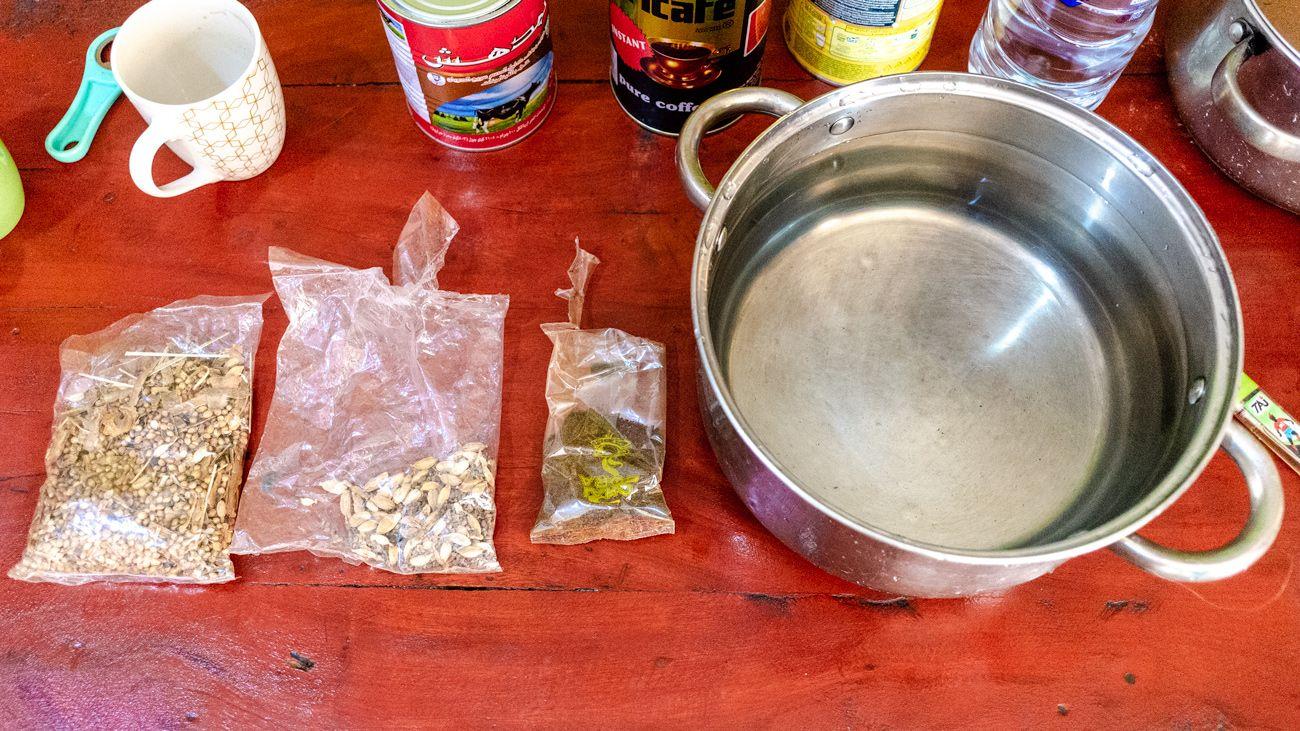
The perfect tea includes ingredients like cardamom, known as liki, mysterious little balls called girigrany, black pepper, lemongrass, cinnamon, and finally, just a hint of tea.

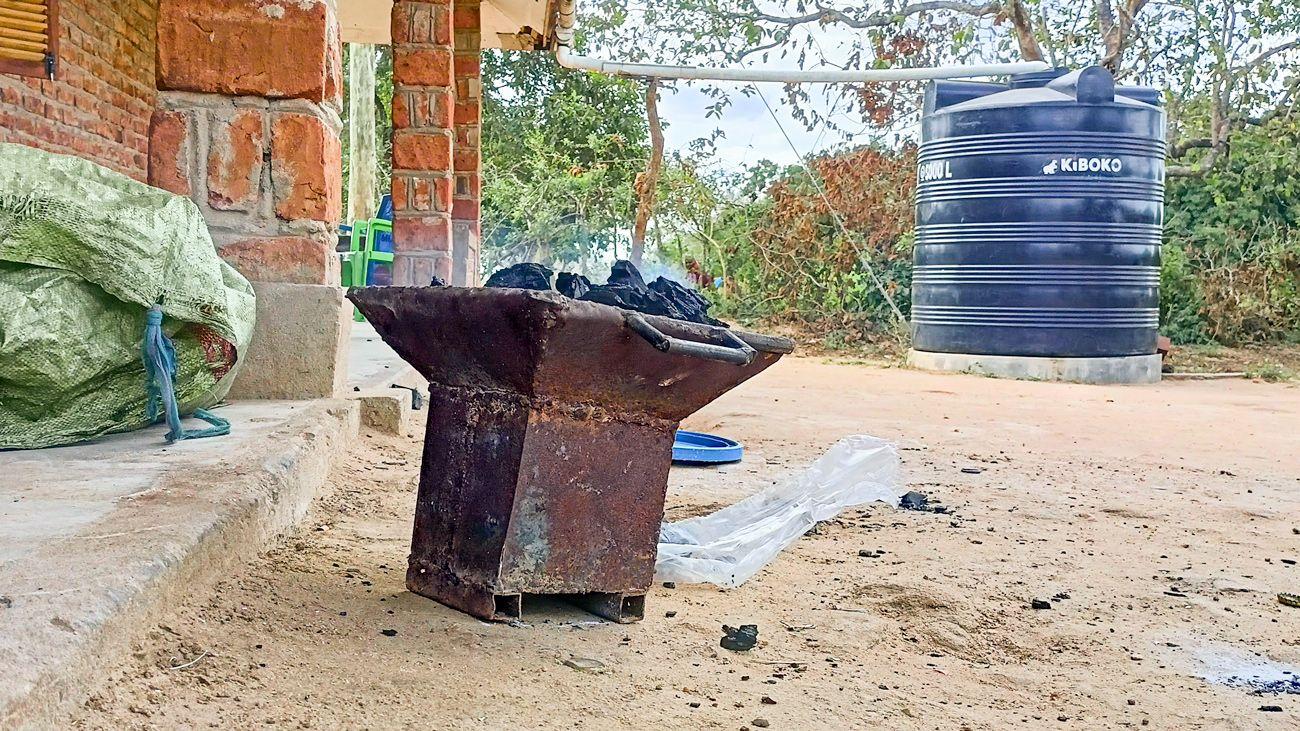
Making tea in local conditions wasn’t exactly straightforward. First, you needed to light the jiko—a small iron stove powered by charcoal. It had one sneaky trait: it only worked with charcoal. And charcoal was never, ever where the jiko was. I invite you to join me on an adventure of tea-making. It begins with Renča cheerfully shouting that tea needs to be made and ends with wiping spilled tea off the table. At the start of this theoretically well-thought-out but practically haphazard operation, Renča discovers that we’re out of tea. The discovery is simple: open the two-liter thermos, where tea is usually kept, turn it upside down, and if nothing comes out, it’s clear—there’s no tea.
At this dramatic moment, Renča decides that someone has to make tea. Since I’m the older European ignoramus and Sekenoi is a kind, non-confrontational young African, guess who gets the job. And so, the mission begins! This moment might deserve a movie clapperboard, but we’ll do without one. The second Sekenoi hears the assignment, he leaps out of his chair, and in five minutes, the tea is ready.Of course, that’s just a joke. Take two! The first attempt flopped; let’s move on to the next scene. If the thermos has any tea left, he dumps it into the nearest glass and nonchalantly delivers the news to Renča. 

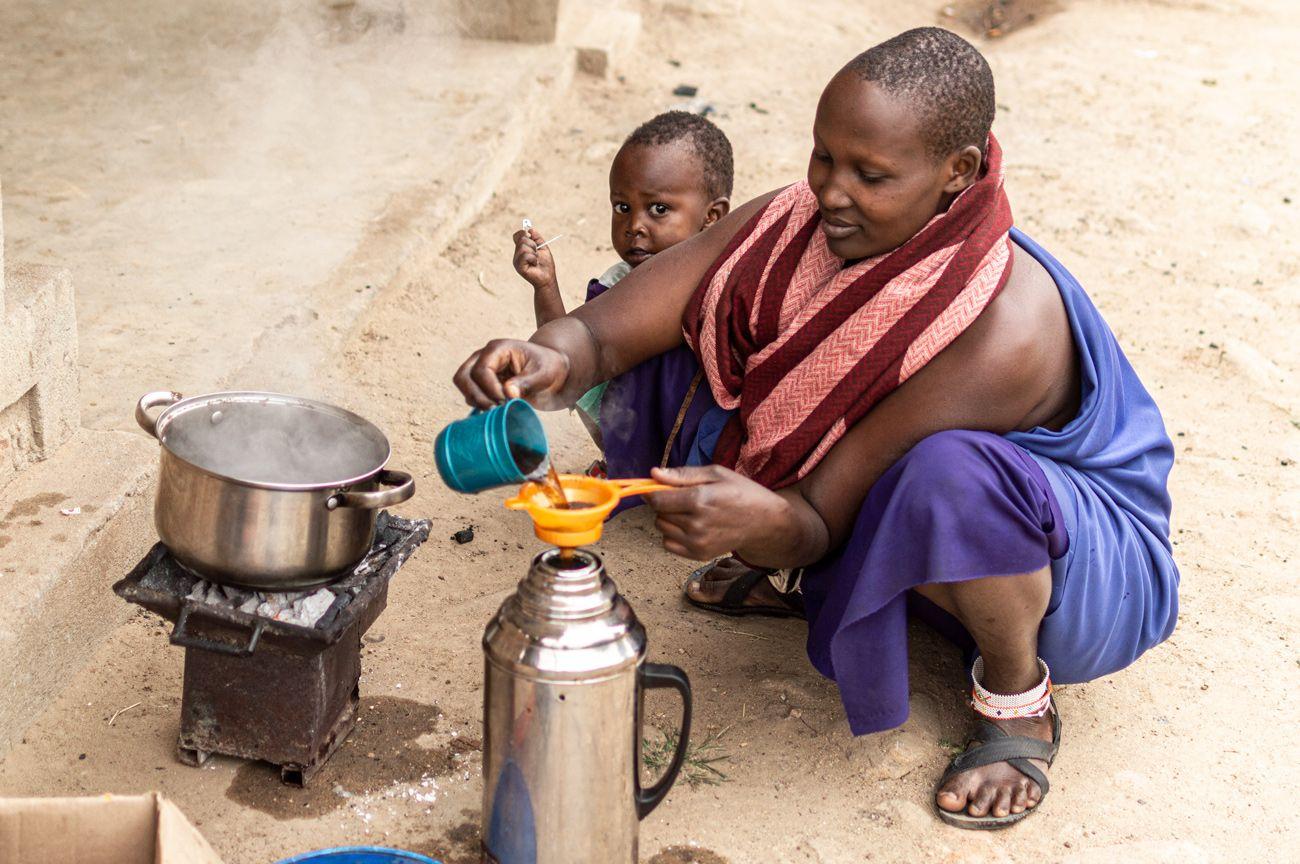
Roda is just finishing the tea, the head in the background belongs to Stella.

After a passionate discussion about whether the thermos is full or half-empty (one day, I might write a book titled Pointless Questions in Culinary Arts), Sekenoi finally concedes that any resistance is futile and gets to work. I would like to emphasize the word "slowly." Very slowly. Fortunately, the small iron stove powered by charcoal, known as the djiko, is usually not a problem. It’s exactly where it’s supposed to be—sitting in its spot, approximately 50 meters from the house. Officially, the mission is underway: the thermos is empty, the running shoes are laced, the shorts are ironed, and the djiko is within reach. Which brings us to the start of Chapter 2—Charcoal.
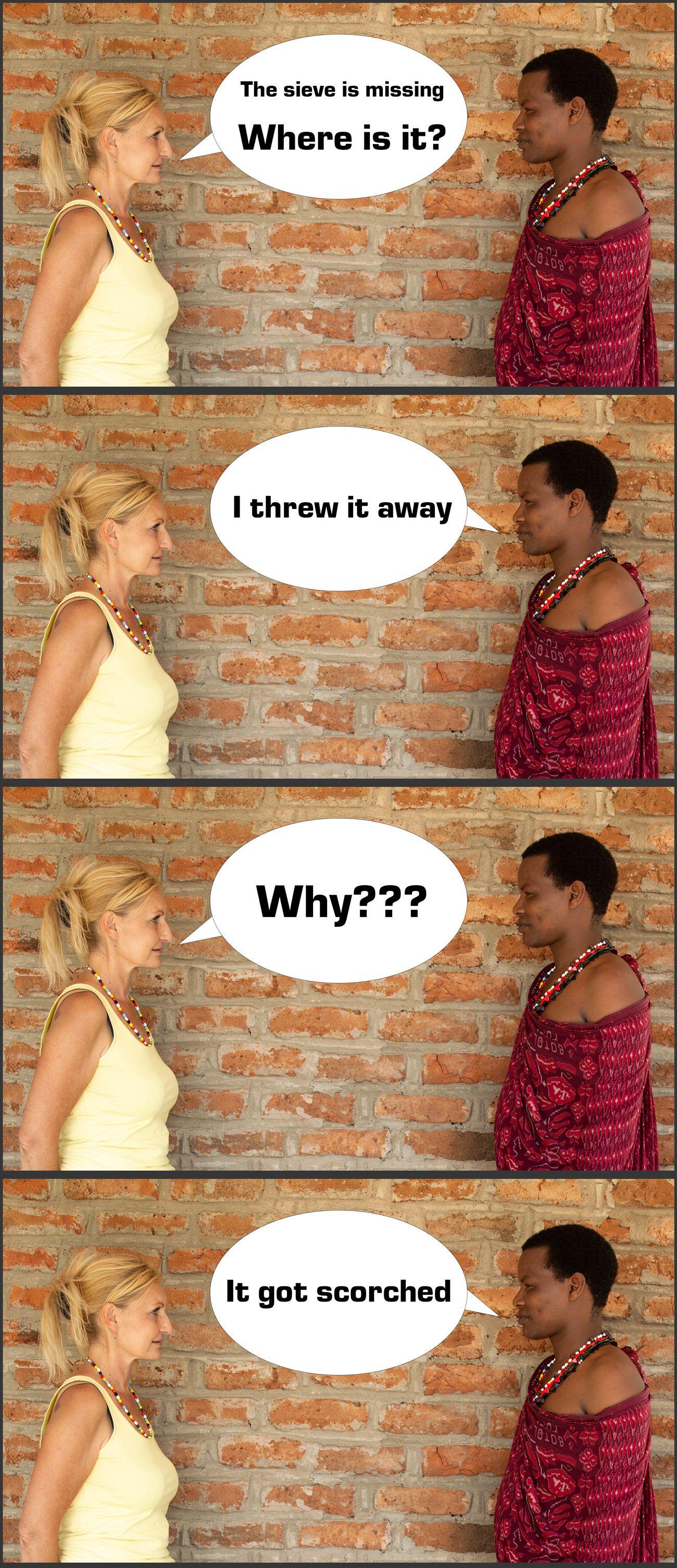
As I’ve mentioned before, charcoal is sneaky—it has a habit of hiding underground, where it’s nearly impossible to find. Thankfully, ours is wooden, African, and most definitely not buried. Unfortunately, charcoal has other ways of being problematic—it’s hard to use it when there’s none to be found. There’s no charcoal in the kitchen, none in the shop, and not even a trace of it anywhere in the house.

Step one on the charcoal journey is just 10 meters from the house.

Sekenoi hops onto the motorbike without hesitation. Once he’s on it, it’s immediately clear who’s in charge. With confidence and style, he rides about 50 meters to the person selling charcoal. On his way, however, he bumps into a group of Maasai with “breaking news”—events from the past hour, during which they stood around discussing what had happened. Sekenoi would love to stay and chat about events that are yet to unfold in the next hour, but he’d have to wait for those.
In the end, he realizes Renča would yell at him. And since Maasai generally have sensitive ears, they might lose part of their hearing. Sekenoi returns home about an hour later, still without charcoal. He couldn’t find the seller, but he met someone who knows a guy who sells it. That guy promised to let him know when he finds him. The timing is perfect—Sekenoi comes back about an hour after he left, just five minutes before the man on a motorbike arrives with a sack of charcoal.
So now we have Sekenoi, charcoal, the djiko, Renča, and me, though I still have no idea what purpose I serve here. Pouring charcoal into the stove and crushing it slightly is no problem at all. It’s a moment of tension: the djiko is placed outside to avoid the smell indoors, but with no flat ground around, it has to be balanced just right to keep the tea pot steady. The tension stems from Sekenoi’s firm belief that the djiko is steady, contrasted with Renča’s certainty that it’s so off-kilter it will take both the stove and the pot down with it. To me, the whole thing is pure fun, and I can’t help but throw in a bit more fuel to the fire. 

Charcoal and a djiko standing close, almost perfectly upright. Take a moment to cherish this rarity.

Only later did I realize that for the Maasai, building something perfectly upright and perpendicular to the ground might truly be a challenge. In the bush, everything is skewed, and right angles are a rarity. Branches, trees, shrubs—they all grow at an angle, making it genuinely difficult to find a right angle. Back home, it’s the exact opposite—a paradise of right angles and vertical lines. Everything is square and upright; from childhood, we’ve been used to how things “should” look. So the djiko and the Leaning Tower of Pisa are my two favorite slightly less-than-perpendicular things. Renča twists the djiko on the ground in various directions, trying to find the flattest spot possible. When she finally succeeds, she proudly shows it off to everyone.

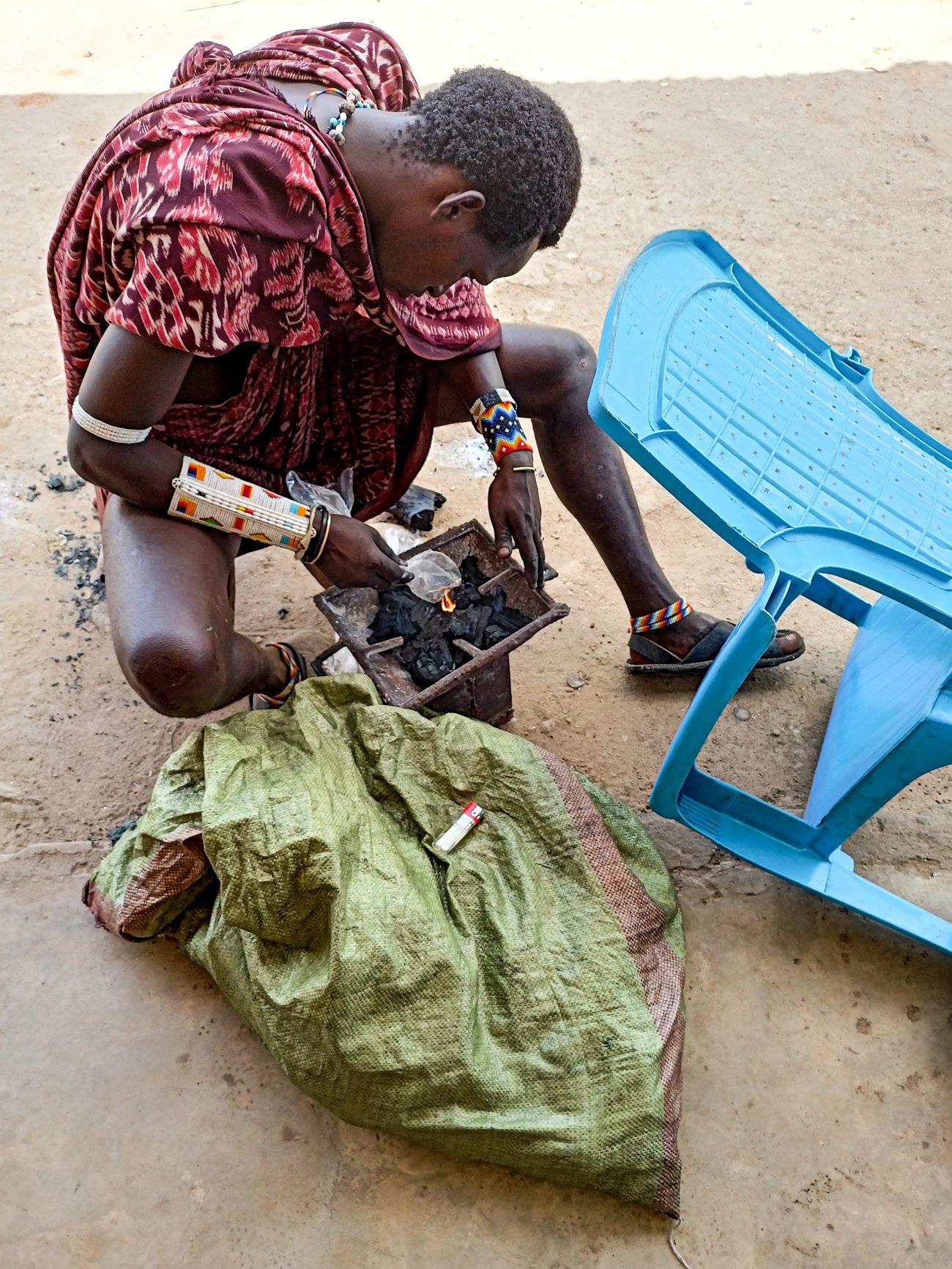
This is the magical place where the djiko creates a perfect right angle with the earth, the house, the sky, the sun, and, naturally, a passing donkey. The Maasai look at this in confusion, unable to understand what difference the djiko’s position now makes in comparison with the one before.. The whole situation reminds me of a computer game where you carry various items from one place to another, only to have a giant rock fall on your head and kill you in the end. And you still don’t understand why. The djiko isn’t lit yet. The next step is to get it burning. For this, a thick, sturdy plastic bag is used. You light it, and fiery drops start dripping onto the charcoal below. The drops keep falling until the plastic is entirely consumed. The smell of burning plastic spreads everywhere, and the charcoal begins to smolder gently.
Since this process would take too long on its own, you need to fan the flames using the lid of a bucket. And not just any lid—it has to be a blue one. Nothing else would work. The djiko is finally burning. The operation has been underway for two hours with unwavering intensity. And so, the concluding step—both triumphant and near the finish: placing a 2.5-liter pot of water on the djiko, then waiting with bated breath to see the result.

Ndari, a sheet of plastic, charcoal, the djiko, and a chair carefully monitoring every detail.

Making tea at home in Europe, after experiencing the Maasai algorithm, feels like a task designed for people with dull minds and weak muscles. The European algorithm is far too simple:


  • Turn on the electric kettle (a one-click operation).
  • Place a tea bag in a cup (manageable for most without instructions).
  • Wait two or three minutes for the water to boil (time complexity: laughably low).
  • Pour the tea, and you’re done (skill level: equivalent to a worm with five minutes of training).


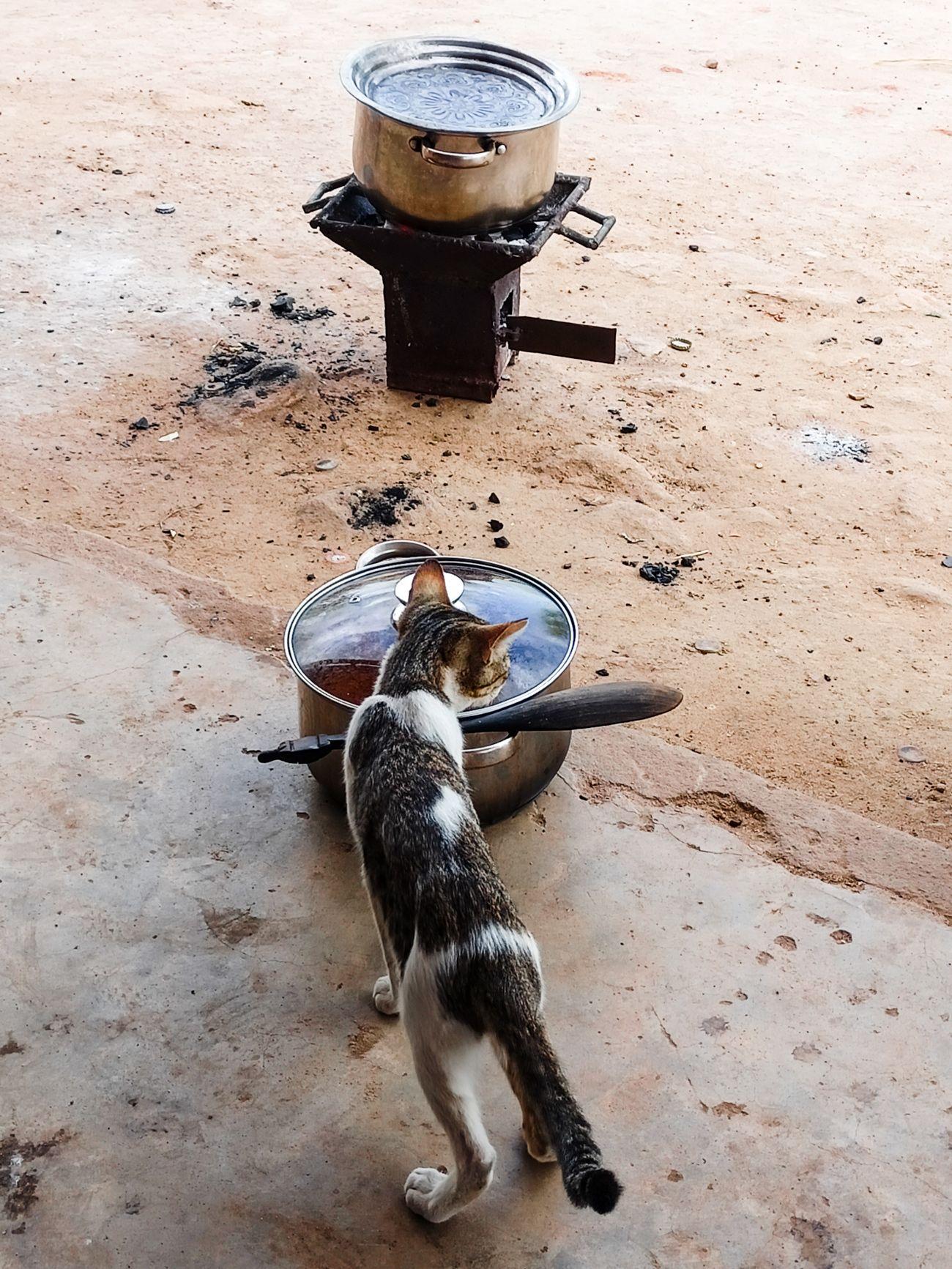
The Maasai algorithm is a world apart. Each step is an adventure: tracking down the charcoal, bringing it over, crushing it, igniting it, balancing the djiko, and eventually placing a pot of water on it.  The whole operation has countless variables, and each one has the potential to cause complete disaster. 
 

The cat observes the result in quiet awe, while the djiko carries on at its usual pace.

I envy their ability to turn even the simplest of tasks, at least for us, into a grueling journey full of obstacles and adversities. In the end, though, despite great sacrifices in lives, morale, and fuel, they manage to overcome the journey. And it doesn’t matter that at its conclusion there isn’t a Holy Grail but just a simple cup of tea.

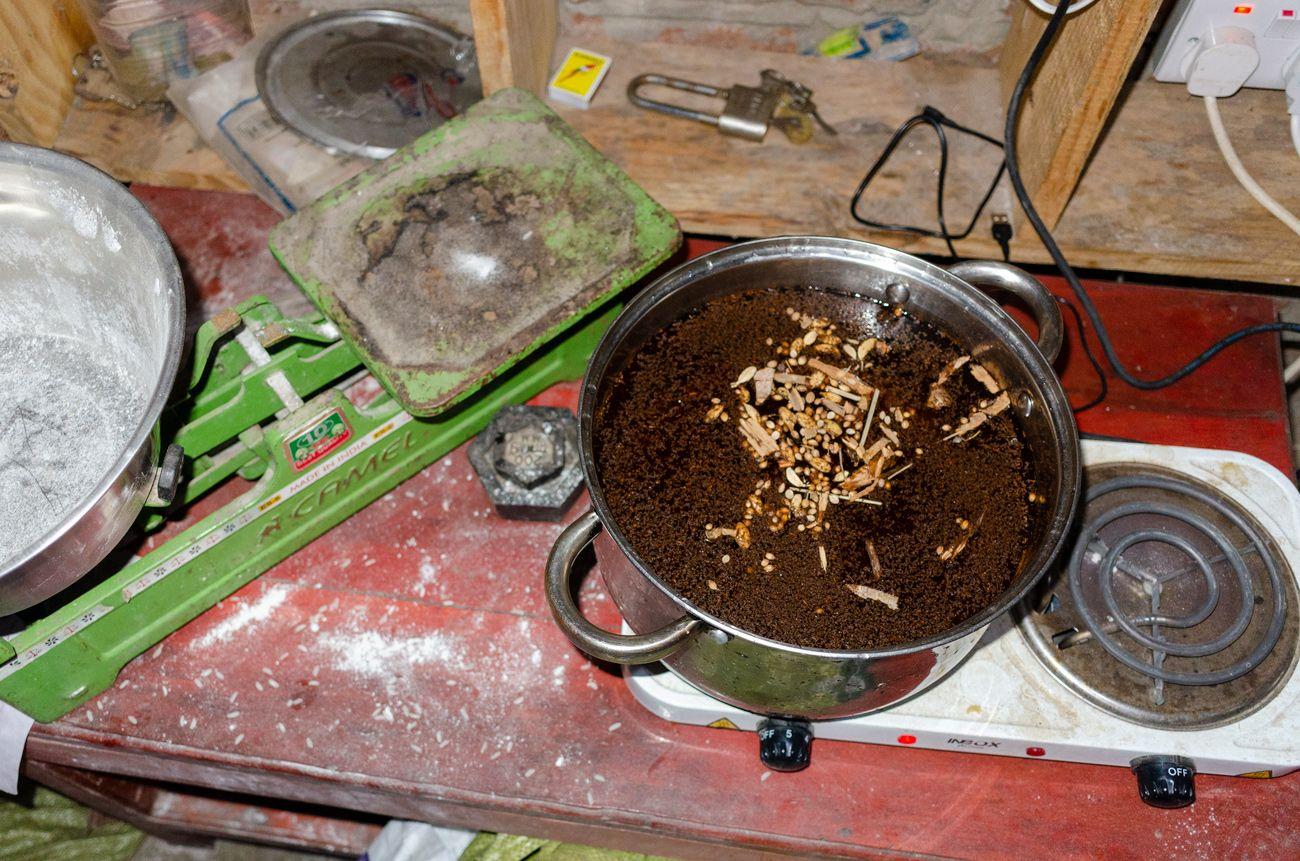
Progress, electricity, and a two-burner stove are unstoppable.

But since misfortune doesn’t only befall people but also the Maasai, this story doesn’t have a happy ending. Electricity, known as umeme, was introduced into our house. And, of course, Renča bought a classic two-burner electric stove (though I was the one who wanted it—but don’t tell anyone). At first, the locals eyed it with suspicion—after all, electricity had only been in the house for a short while. They touched the burners, which were indeed hot when switched on. Questions arose, like why the burners didn’t heat up when the cable wasn’t plugged in, and other beginner inquiries about the electric world.
In just a few hours, however, they got used to it, and the djiko rested peacefully in the corner while the electric stove hummed away, often at full capacity.
But don’t worry, dear children, this story doesn’t have such a bad ending. The electricity worked about as often as it didn’t, which meant the stove wasn’t in constant operation. Cooking on the djiko wasn’t an option either—it was just too much work, so we often ended up without tea altogether.

Share this

I’m sitting at home, sipping coffee at my computer, when the phone suddenly rings. After ten years, Renča called. She wasted no time surprising me: she wanted an animation for her website. Apparently, she’s raising money for Africans and wanted the site to show her progress. She envisioned an animation where a glass would gradually fill up, showing how much money she had collected and what it could accomplish.
"Great, wonderful," I thought to myself, "another do-gooder raising money for Africa. Meanwhile, we barely have enough for ourselves."
Images of Africa raced through my mind. Shots of sleeping children with flies crawling across their faces, cheerful kids shouting in school, thousands of hungry hands, and sorrowful gazes. I pictured the bush, where lions lounged lazily on every tree and happy antelopes leapt around. And then, at the end of the day, everyone would cuddle together and fall asleep peacefully, unbothered by tourists, worn out from a full day of leisurely activities.
Fast forward five months and several Turkish soap operas later, I found myself in the middle of nowhere in Tanzania, in the Lengusero region, the village of Mbogoi.  I sat there, thinking about how to raise money for them and use it as wisely as possible.
I have great respect for people with firm principles.

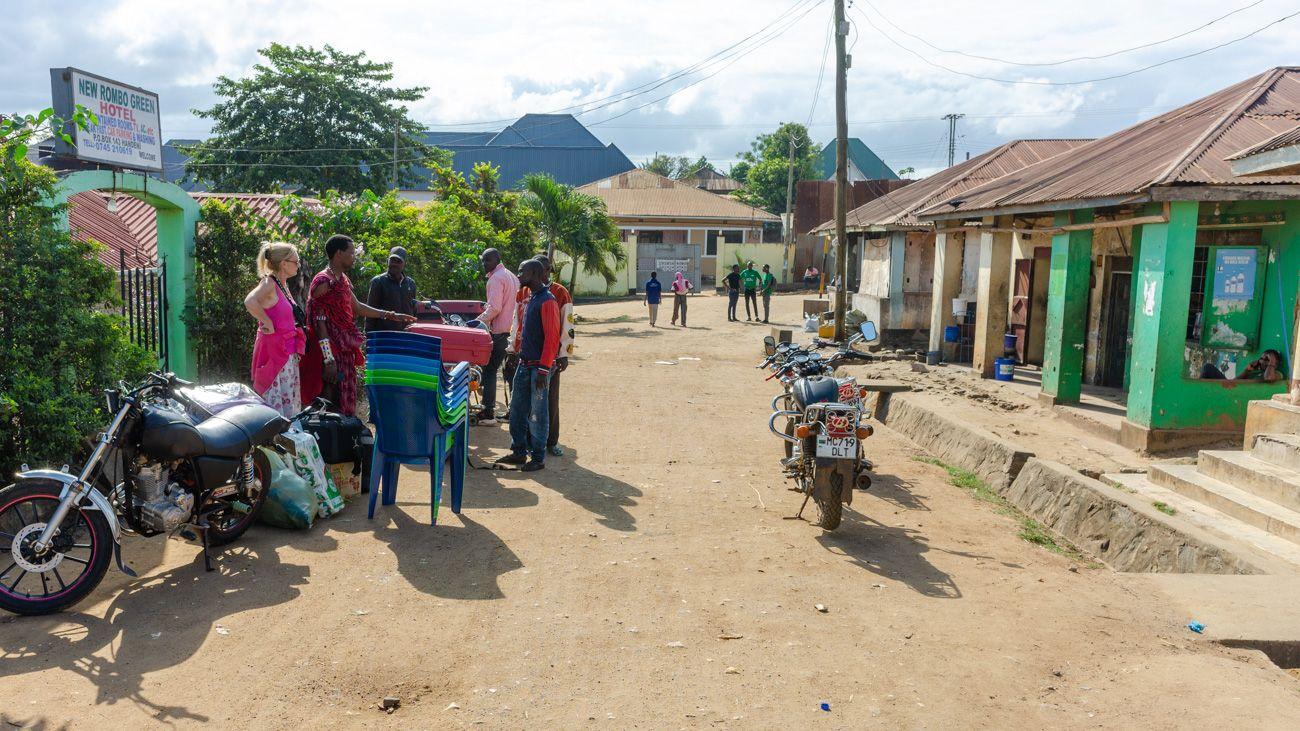
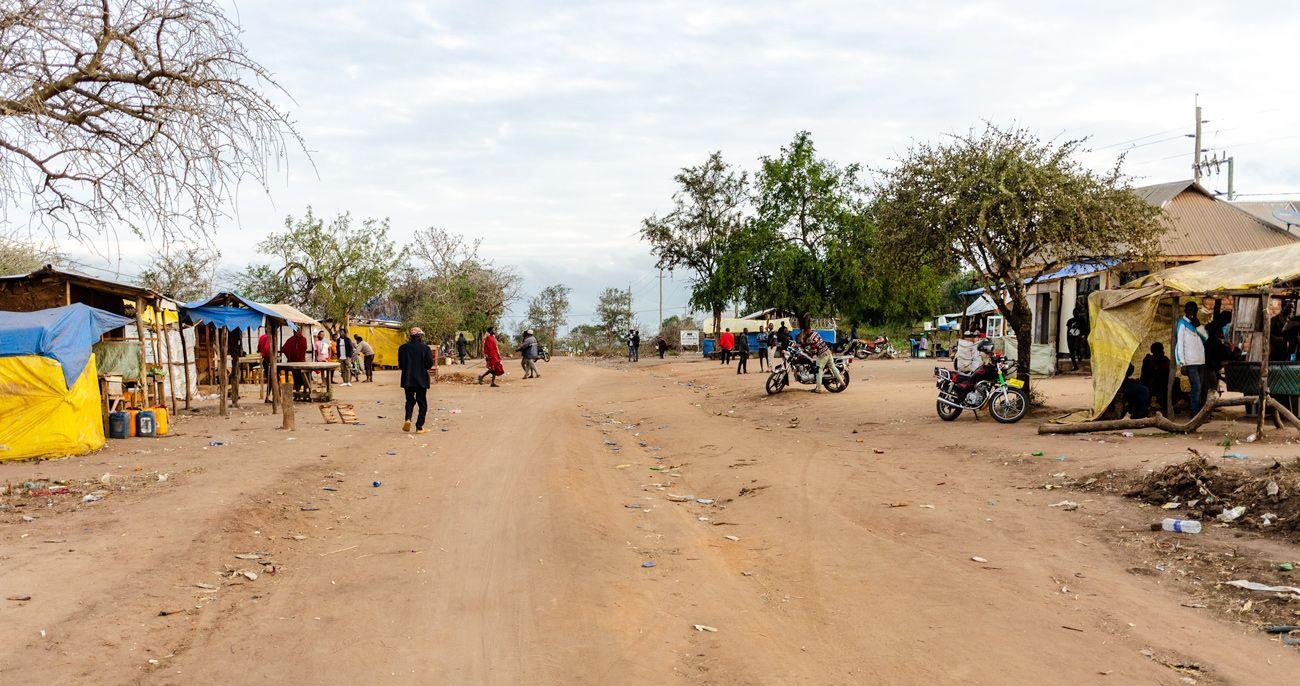
The main street of the village of Mbogoi.

If anyone is bothered by the fact that I’ll be referring to the people of Mbogoi and its surroundings as black, they’d better stop reading now. I asked several of them directly if I could use this term. They were surprised and wondered what else I should call them since they are black, just as I am Mzungu (Swahili for "white person") and I’m not offended when they call me that. So, I’ve got explicit permission from the target group. Other Afro-Africans and people of very dark skin can rest easy.

So, Mbogoi. A picturesque inland Tanzanian village with a population of 100–150. Even the mayor, Munikity Julius, couldn’t give me an exact number—not even after ten beers. The population is rising rapidly; who can keep track? Every second house here is a shop, a street food stall, a pharmacy, or a tailor. There’s a hospital and a school too. And in every house, Swahili people.
The most notable features of Mbogoi? Extremely low incomes, ranging between 50,000 and 100,000 Tanzanian shillings per month (about €15–45 at the current exchange rate), and possibly the highest number of street food joints per capita in the world. 

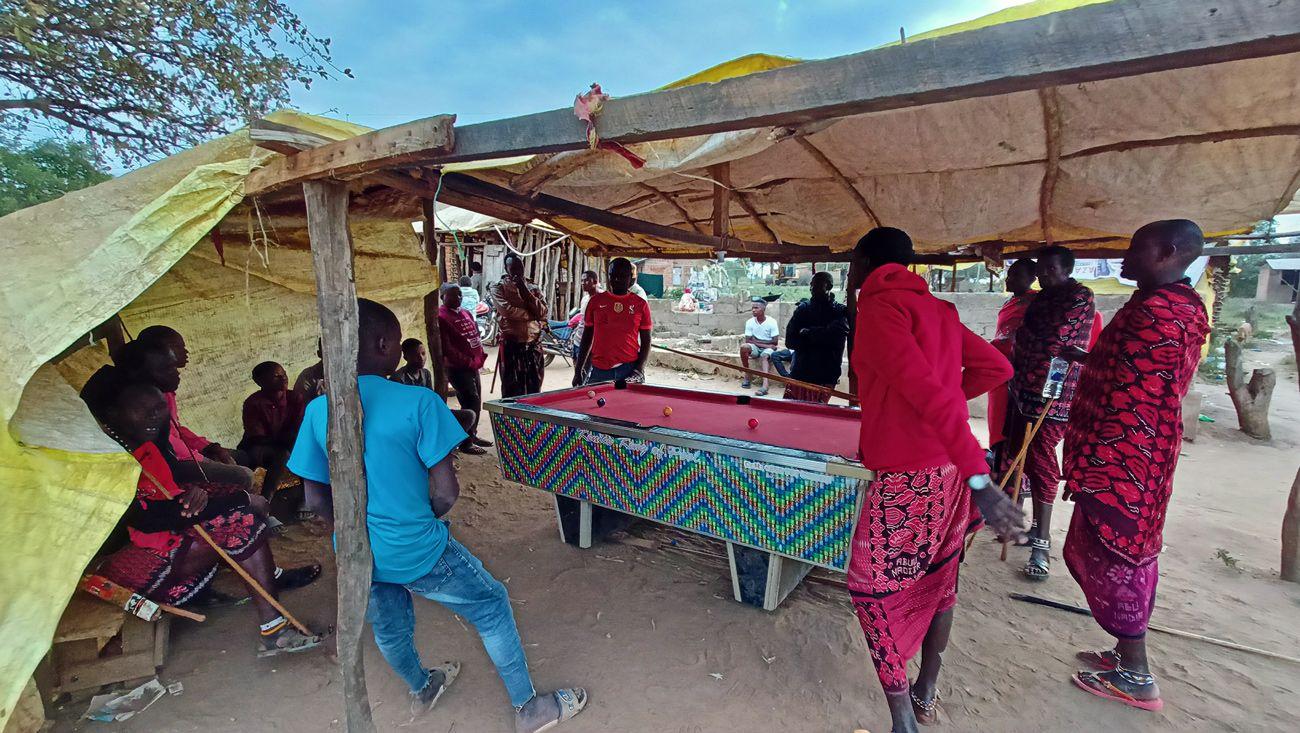
Social and cultural life here in general.

This idyllic little village is located in Tanzania, about 40 kilometers from the town of Handeni, which you can even find on a map, and roughly 150 kilometers from Africa’s eastern coast, near the Tropic of Capricorn. From Handeni, if you’re traveling by road, head west, and in Mafulete, turn right through Mkindy. You can’t get lost—there’s no other way to go. When I say road, I mean road, but I picture an African road. 

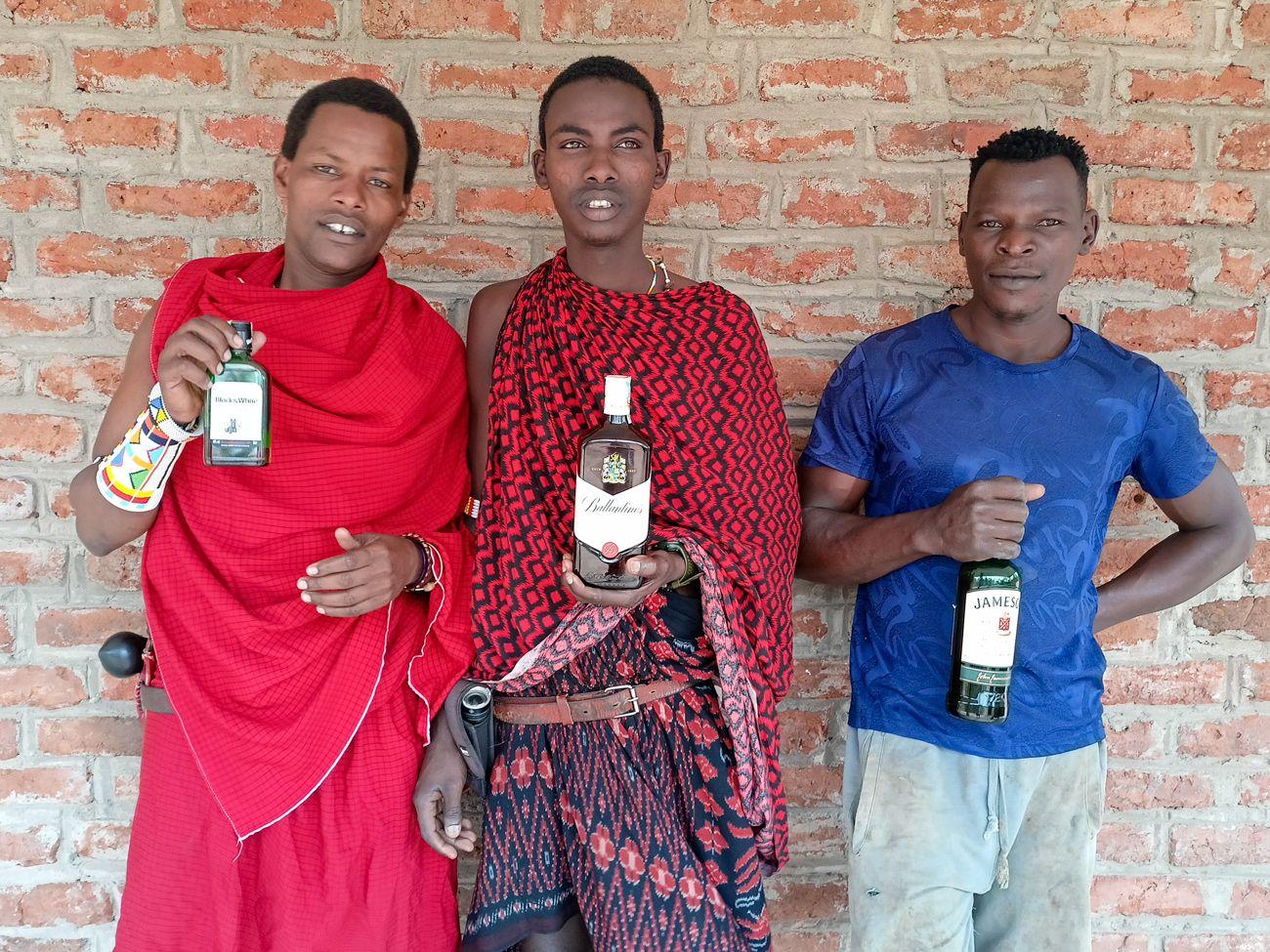
From left to right: Maasai - Maasai - Swahili. From right to left: Jameson - Ballantine's - Black & White.

The Maasai divide people into Maasai and other black people – Swahili speakers. And mzungu – white people. In the village, Maasai don’t usually live or sleep, except for a few exceptions that can be counted on the fingers of a disabled hand missing two and a half fingers. The exceptions are, namely, Sekenoi, Koikai, and Alojz when he drinks too much Konyagi.
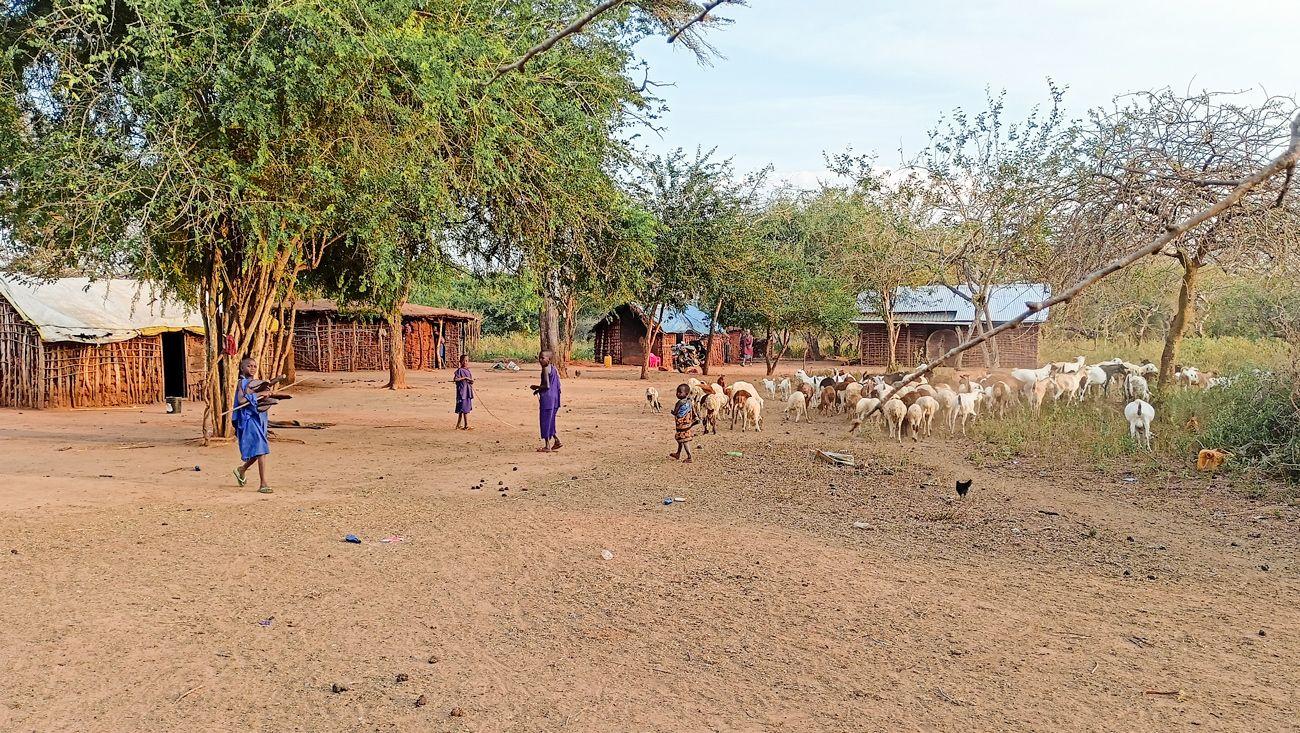
The Maasai only come to the village when they feel an urgent need to discuss something – which, basically, is always. They live in a boma – a small settlement consisting of three, four, five, or six mud houses, and enclosures for cows, sheep, and goats. Every evening, they return there to sleep. Bomas around here come in all shapes and sizes: big and small, poor and rich, far and near.

Uncle Boma's cabin.

An important note: Africa is one big "maybe," so I can’t say for sure that what I experienced, heard, or am writing about applies even 10 kilometers away. Things could be completely different there. And they very likely are. Africa.

Share this

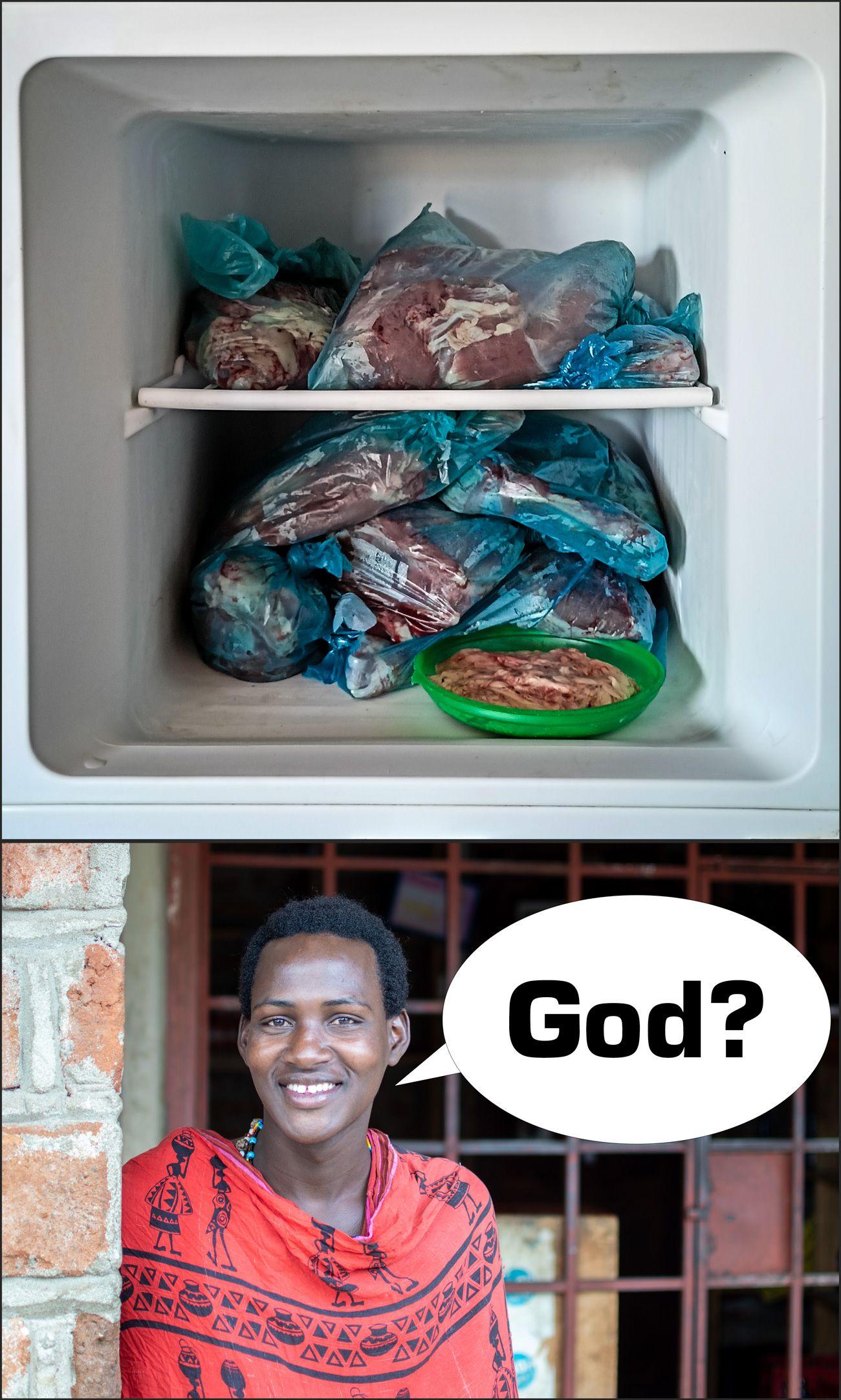
On the fifth day after my arrival, umeme (electricity) was finally connected, and I made one of the most significant decisions of my life - to go to the shop and photograph a goat in a freezer. Progress, frost, and a goat - none of these can be stopped, not even in Mbogoi.
In the shop, which is practically just one room in a house, sat Ndari as usual, often saying an unsurprised "Yeaaah?" while staring blankly at his phone. He had been replaying his favorite Tanzanian song - rhythmically tangled and melodically intricate—for what felt like the 256th time. Ndari is quite an entertaining Maasai. He doesn’t know when he was born; by his own estimation, he’s "about maybe approximately" 25 years old. Recently, he got into a fight and now owes a fine of 200,000 shillings and two goats. For a cow herder like Ndari, that’s about four months' wage — a significant sum.
So, he started working in the shop, where the pay is slightly better.  Ironically, about a month later, someone beat up Ndari, but the offender didn’t have to pay a fine because, as the saying goes, no blood, no foul.  Progress, frost, and a goat - none of these can be stopped, not even in Mbogoi. With a vacant stare, he scrolled through his phone, looping his favorite Tanzanian song — a chaotic mix of rhythm and melody - once again.
"I go to take picture of goat to the fridge." I casually tell Ndari, just to keep the conversation flowing. Ndari lifts his head briefly, looks at me, and asks, "God?" before turning back to his phone.
Yes, it’s me - the almighty mzungu, personal photographer of God in a freezer.
Share this