Everyday Weapons

Listen to this text

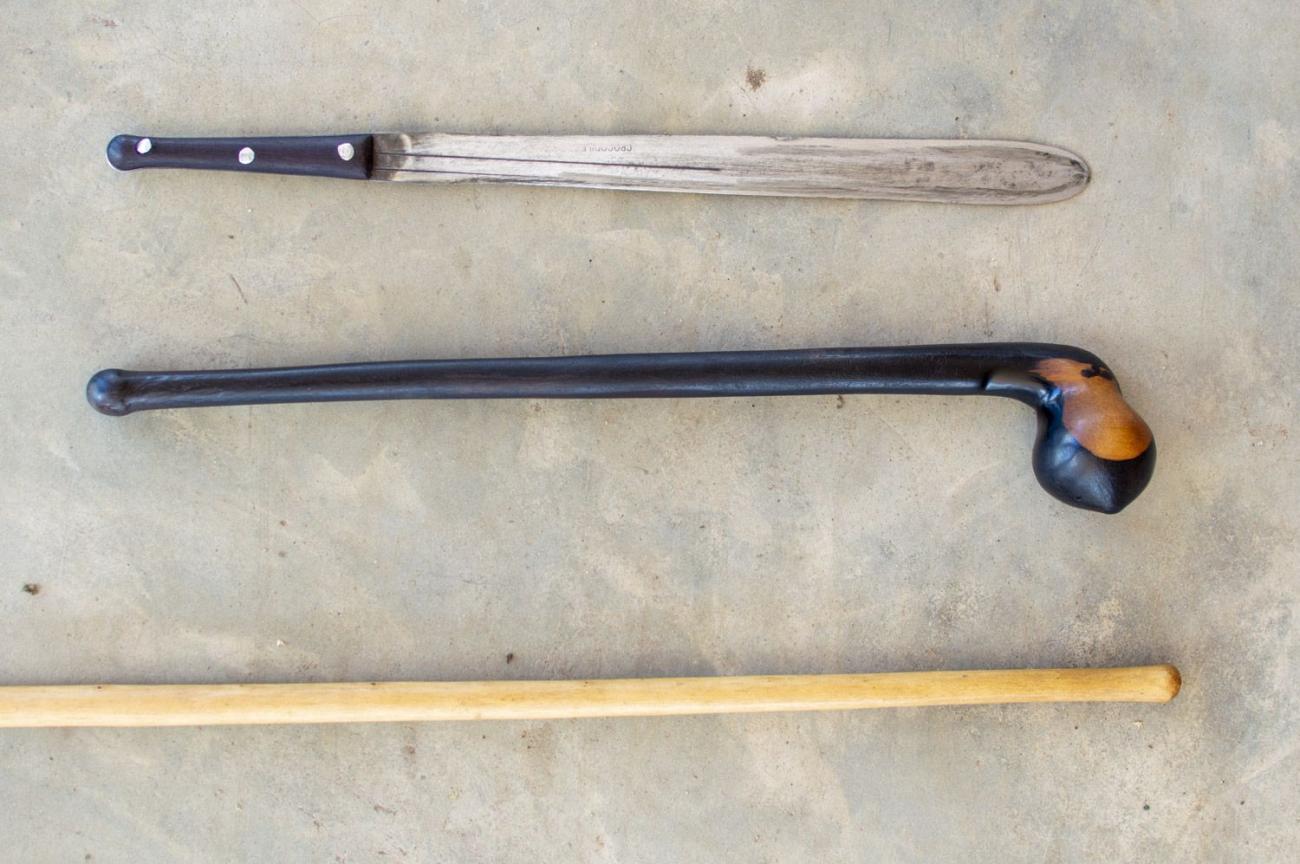
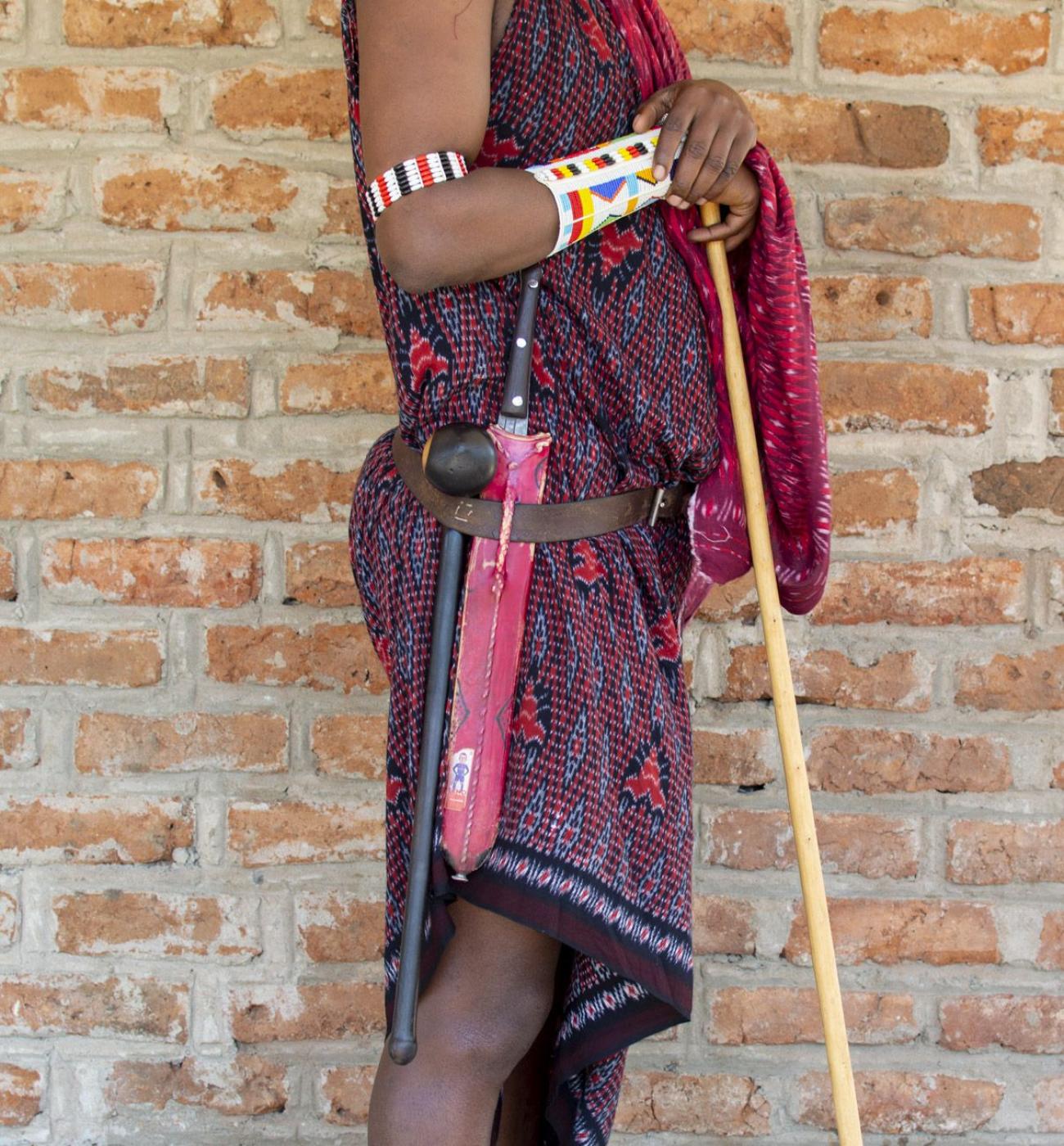
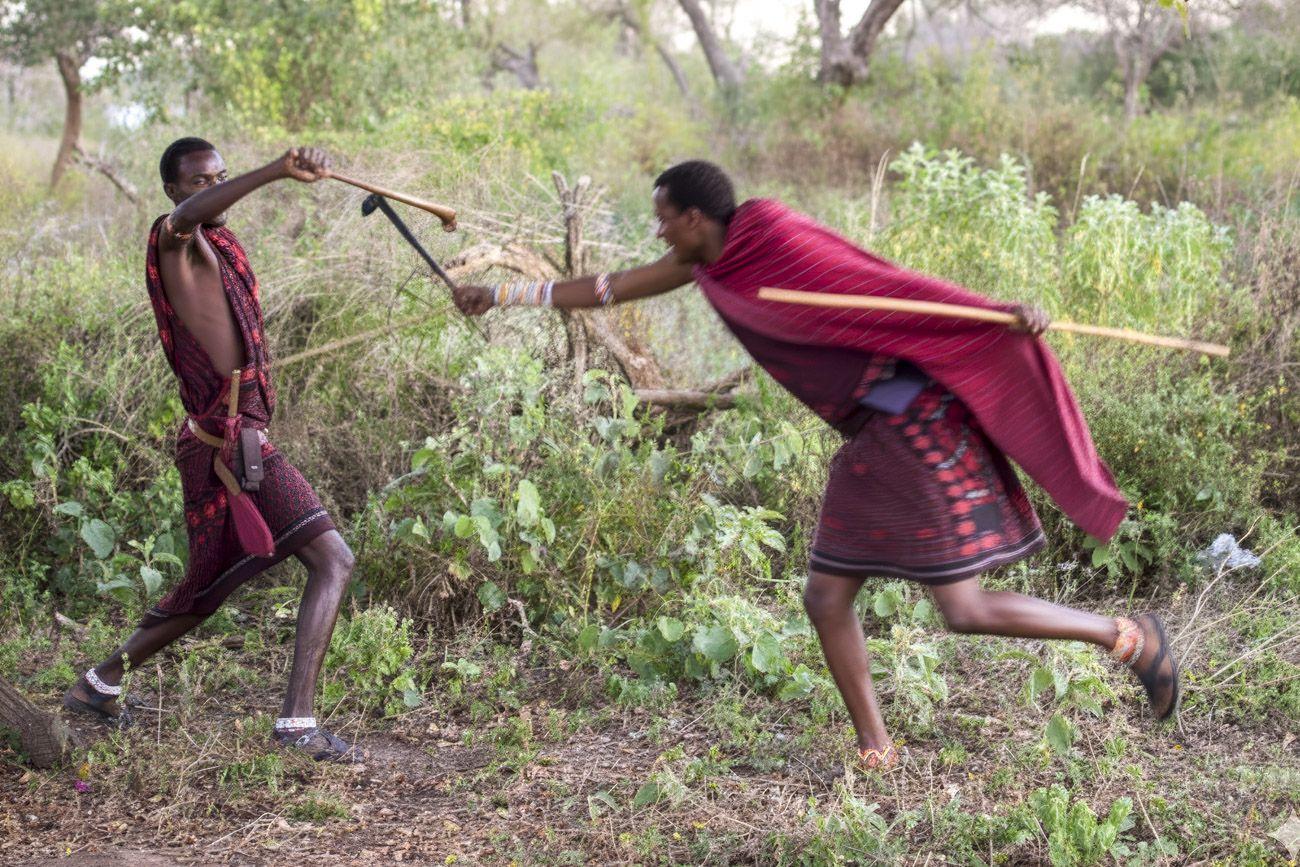
The Maasai have a remarkably warm relationship with their weapons. They mainly use three: the short machete called orbanga, the rungu, which looks like a wooden hammer, and the stick known as emudi, which has an impressive range of applications. They wear their weapons practically all the time. In the morning, when they get up, they strap on the orbanga, grab the emudi, and head out into the streets of the bush.
They presumably know how to handle them, because they’ve been playing with them since childhood, and when they advance to warrior status, they spend a year in a training camp learning how to use them properly and survive in the bush. In the shop there was also an iron spear leaning against the wall. In reality, it was a rusty rebar rod with one end forged into something sharp. About other weapons beyond the three I mentioned—like the spear—they were rather reluctant to talk. Presumably they’re banned by the state, so I don’t know the details.

The short machete, or long knife. Its primary function was to swing elegantly at the hip, but it occasionally proved useful—for instance, for trimming a twig used as a toothbrush, or when Sekenoi sliced meat for the kitchen in the morning. He cut meat that would later become rosti or soup. He had an unconventional setup: a wooden board nailed at an angle to a tree at shoulder height. He’d pull out the machete, grab the meat, and hack it into pieces on that board. It had undeniable advantages, because nearly every piece of meat fell to the ground. The soup was therefore certainly more nutritious and richer in vitamins.
Weapons undoubtedly have their purpose, because a Maasai basically spends the entire day walking through the bush with cows. And in the bush, besides snakes and wild, furious tortoises, there are also leopards who enjoy a cow—or a Maasai—strolling freely through their territory. Since the local diet is largely herbal—aside from meat, which is truly rare—and lived out in fresh air, perhaps the flavor profile of a Maasai is comparable to beef. I wouldn’t know, I haven’t tried. I’ll ask. Though I suspect they won’t understand me again. I could try tasting one directly, but that would likely end in a similar misunderstanding. Once I tried to explain the principle of cannibalism, and my words floated away completely uncomprehended.

Another essential component of a Maasai is the rungu. It’s made of ebony and resembles a hammer. Every owner proudly displays how worn his rungu is, because that proves it’s constantly carried. An outsider unfamiliar with these customs might assume this is a nation of handymen. But what exactly would they be fixing in the bush? Shrubs are mostly self-repairing, acacias put up fierce resistance, and when a house collapses, they rebuild it by hand. So the rungu enjoys even more decorative swinging at the hip than the machete. Once I saw Sekenoi use it to chase away a nearby crow. So yes, it truly is a useful tool.
Another inseparable element of the Maasai is the emudi stick. It has a much broader range of uses than the other two weapons. For example, it serves in road maintenance, clearing branches that grow into the path, or for driving cows forward. But its greatest and truly decisive function is the fight against gravity. Most of the time, when they are standing, watching, or talking, Maasai lean on their emudi. Without it, they would simply fall over. It was an ordinary shrub branch, fairly straight. Gradually, emudi began accumulating in the house, one after another, until there was a whole herd of them standing there. When there were about thirty, Renča threw them all out. Perhaps they were already exhausted from their endless battle with gravity.

A funny story. Once we went to the bank in Handeni—Alois, Sekenoi, Renča and I—and at the entrance their weapons were confiscated. Their faces carried a sweet-and-sour expression, and every few seconds they checked with their hands the place where those accessories were supposed to be. They were simply not themselves.
Another story concerns the spear. When someone visited the wife of another warrior, he would lean his spear against the door. When the husband saw the spear by the door, he knew what was happening and calmly waited. Once, however, a friend brought his spear and leaned it against the door because no one was home. Later Sekenoi arrived and saw the spear. He was afraid to go inside, as that would break the custom, but he puzzled in vain over who might be with Renča. He circled nervously around the house until Renča herself appeared, and together they puzzled in vain over who might be with Renča. And with that, I concluded my pondering of Maasai weapons—even though there was no spear leaning against the door.

Share this