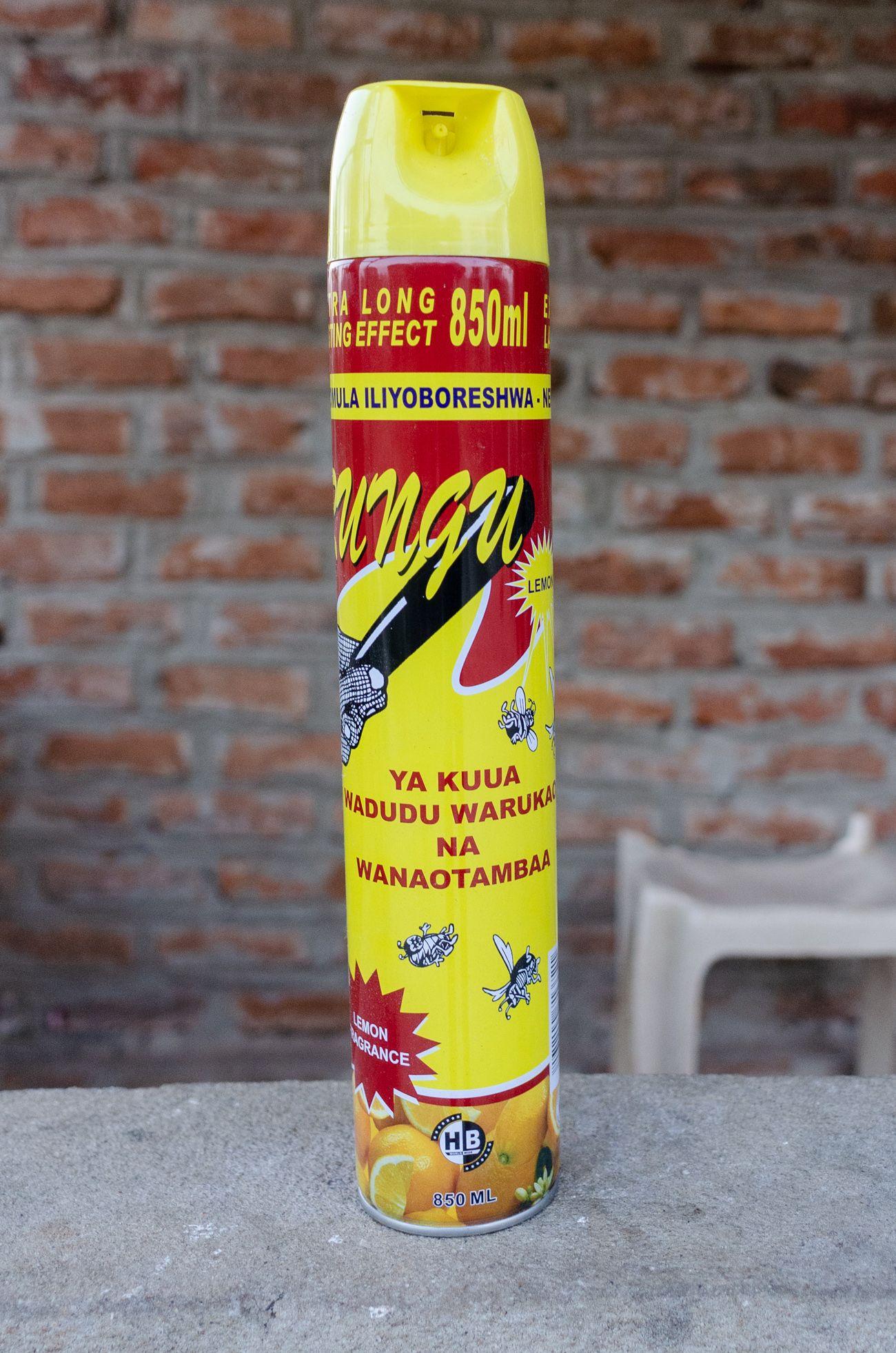
I was probably most afraid of scorpions before coming to Tanzania. Their sting is said not to be fatal, but it hurts. A lot. I even had orders to thoroughly check and shake out my shoes every morning before putting them on, just in case a tired scorpion was sleeping inside after a wild night. It never happened, for two reasons. The first was that Sekenoi sprayed my room every few days with a Chinese all-purpose insect spray, so it always had a pleasant lethal fragrance. The second was that there had once been a scorpion nest near the house, inside an old hollow stump, which had been destroyed. My one and only encounter with a scorpion? Renča told me one lazy afternoon that a chicken had dispatched a small, see-through scorpion.
A Chinese spray that kills everything and leaves behind a strangely pleasant deadly aroma.
Apparently, there are many snakes. I know this only from hearsay, because I might have seen one, but it was dark. It was a black snake, so it probably wasn’t a snake. That’s why we had bare dirt without grass in front of the house, and all the bomas are completely cleared of vegetation, because they say a snake is afraid to leave the grass – this is their protection. For example, near the toilet, which was by the house, there was grass nearby, and I always had to check to see if there was a snake. I even checked above, under the roof, and inside the door when I closed it. Once, there had already been a snake on the door, thankfully about a year before I got there. The Maasai deal with snakes in a highly practical way.Whenever they see a snake, whether it’s venomous or not, they immediately beat it to death. Apologies to all self-proclaimed nature protectors who might be traumatized by this. But who knows what trauma they’d suffer if a deadly venomous snake bit them. And how would they inform others that this snake is highly venomous?
That specific toilet had a snake wrapped along the inside of the door.
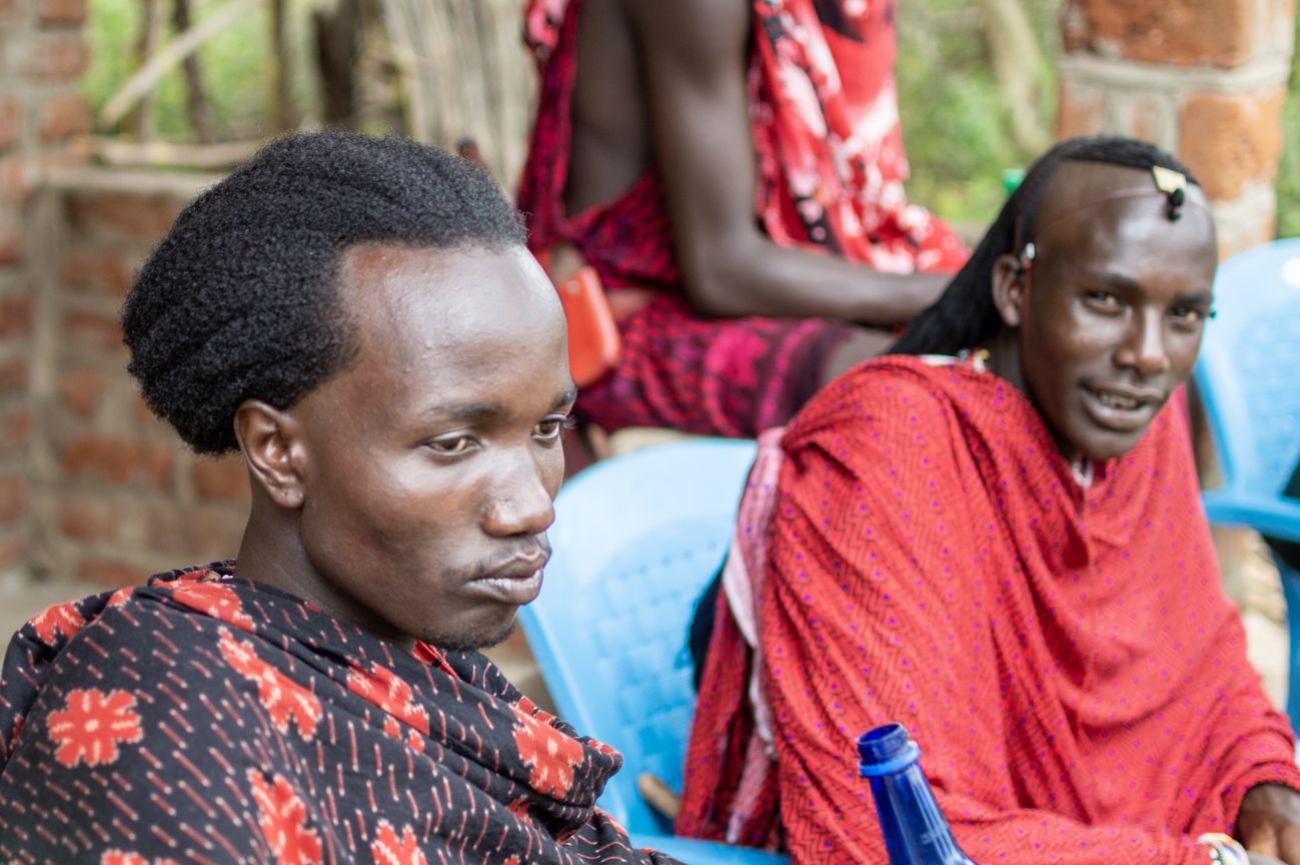
Our idea of Africa, as Europeans, is that it’s full of animals. There are supposedly so many of them that they can’t even move, and in some places, they create huge piles. I don’t know – where I was, the animals could move freely, they had plenty of space. The only problem was that there weren’t any animals there. Among all the wild animals, leopards are the undisputed legends. At least once a day, someone mentions them. Leopards, they say, are not fans of fair fights – they sit in trees and attack from behind, trying to bite their victim’s neck. Often, though, they end up biting the head instead. That’s why the Maasai, who hold warrior status and mostly herd cattle, are allowed to grow long hair. They don’t need to shave their heads like everyone else – it’s so the leopard bites the hair, not the person.
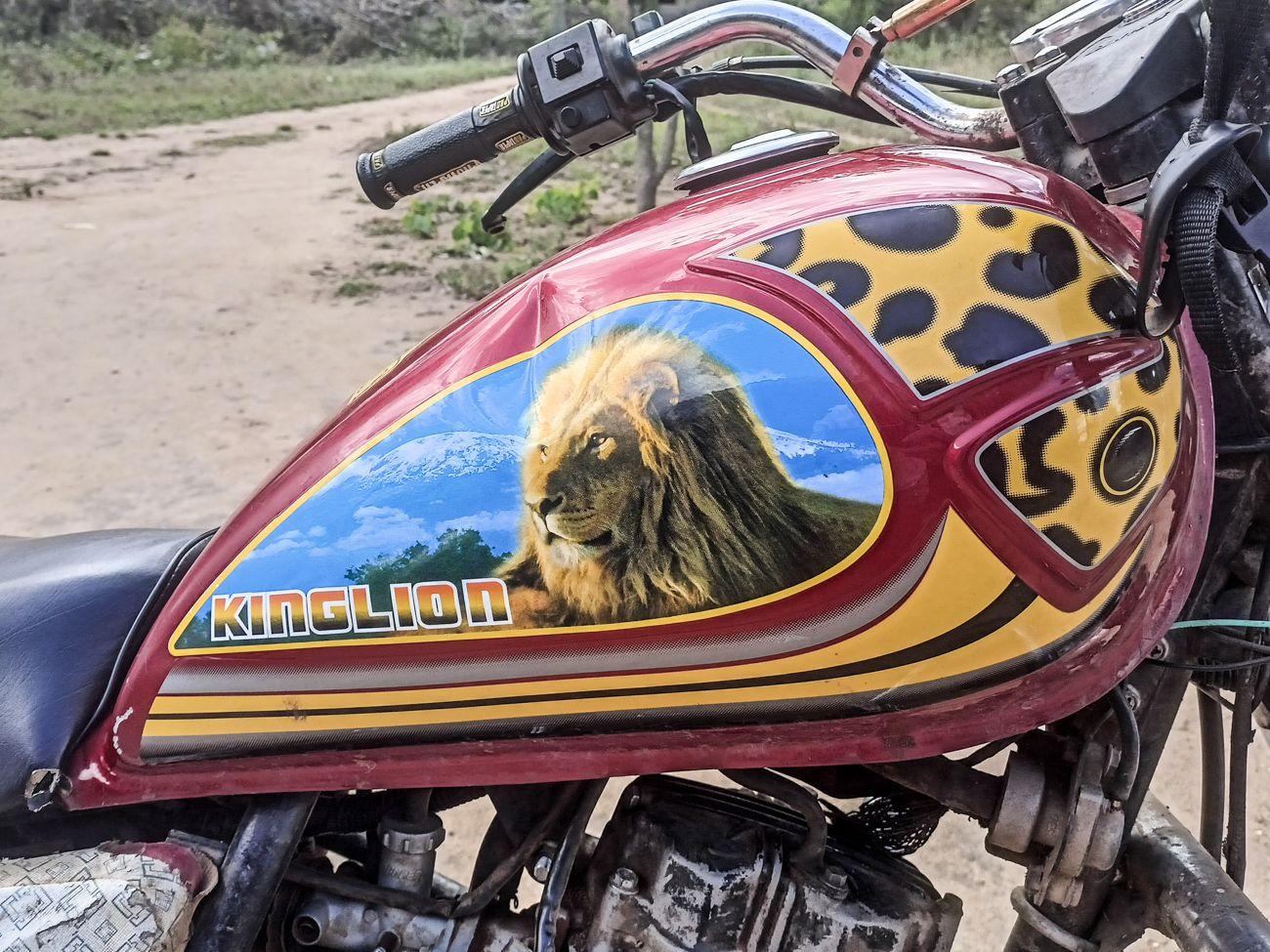
Sometimes, as some said, a lion from the north might occasionally wander down. I don’t know more details, but I learned that the Maasai from a neighboring tribe would form a circle around the lion and sing a special song just for this occasion. The lion gets dizzy from it, falls, and they can safely kill it. I’m convinced that the song must be country – because country music can take down any healthy individual, let alone a lion.
The only lion I encountered was drawn on the side of a motorbike.
Aside from these friendly creatures, elephants also roam the bush. They have the advantage of being large and can calmly push through dense bushes. The downside is that they can devour an entire field. When I was there, this happened to a man named Lamarai. The elephants came and grazed down his entire cornfield, known as shamba, in one night. There’s supposedly a way to protect against this – you plant chili peppers, known as pili pili, among the corn. But who would bother? After all, the elephants are far away, planting pili pili is extra work, and the elephants haven’t been here in ages. And what if it doesn’t work? And a million other excuses – you know how it is. Apparently, you can’t kill an elephant since every single one is tagged with a chip tracked by government satellites. When I suggested they could kill an elephant, have meat for a month, remove the chip, and stick it in one of the cows, no one reacted positively.
Battling leopards with hair.
The only wild – truly wild – creature living in nature that I saw up close was a wild tortoise. It suddenly appeared on the porch. I couldn’t tell if it had a wild look in its eyes, as it was mostly tucked inside its shell. Then, all at once, it fiercely stuck out both legs, thrust out its head with a fiery gaze, and wildly crawled away. Of course, all of this must be viewed from the perspective of African time. From the point of view of the African god of time, it was definitely wild enough. Whether it had a wild glint in its eyes was anyone’s guess – it was mostly hiding in its shell.
The wildest wild animal I’ve ever seen in the wilderness.