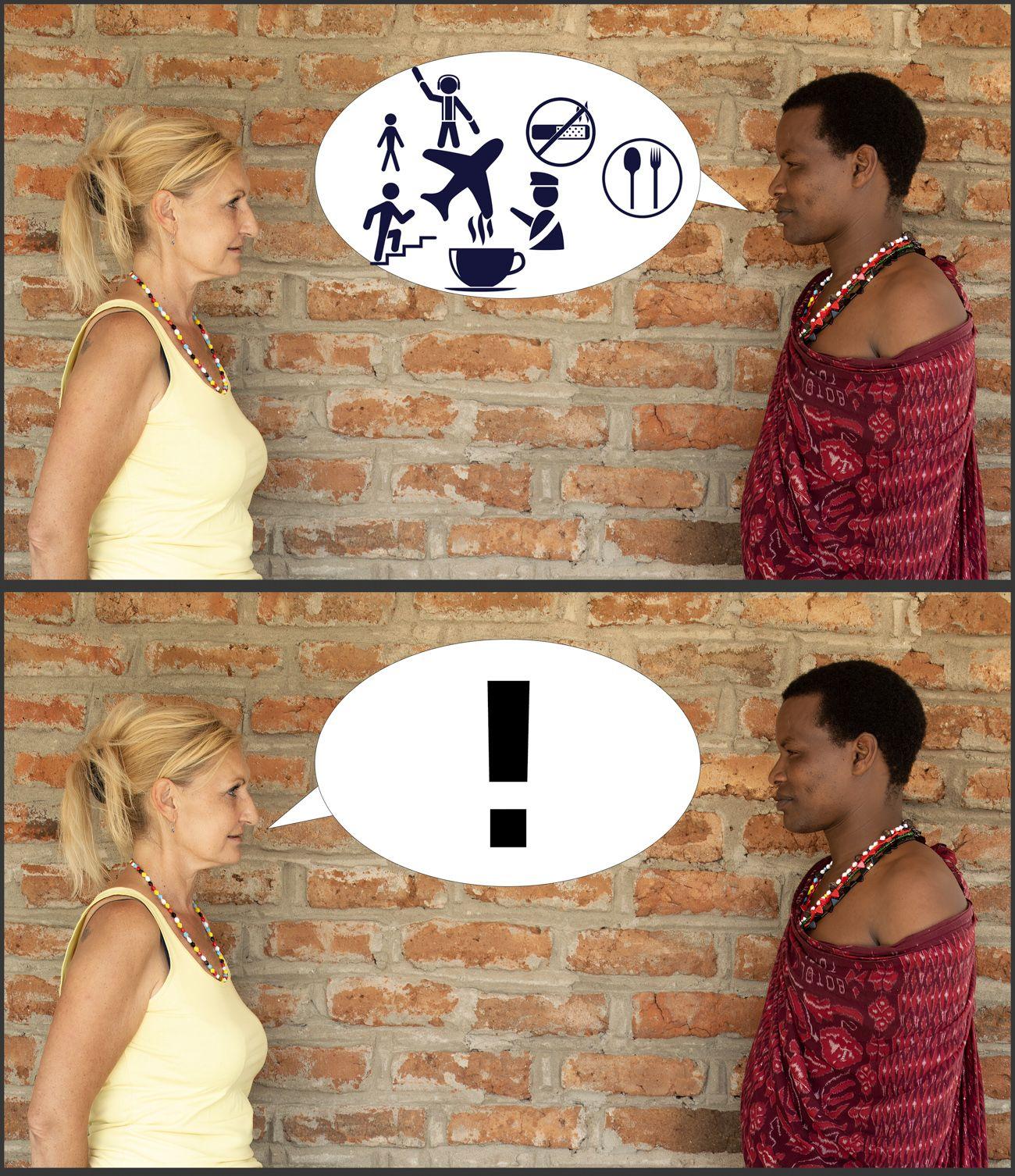
Don’t forget this name – Sekenoi. I started remembering the "S" after about two days. I hope you’ll do better. I’d like to introduce you to Sekenoi and Renča right at the start because they’ll be appearing quite often in this local travelogue.
Sekenoi is a local Maasai (one of the few who permanently live in the village) who stayed in the house with us. He’s a partner, boyfriend, Maasai-style husband. According to his own words, he has three mothers and fourteen siblings. Compared to him, Renča, with just one mother and one sister, looks like an only-child orphan.
Renča and Sekenoi
Renča is Sekenoi’s partner, girlfriend, and Maasai wife. In Zanzibar, they had a nice expression – “Masai Mama.” Sekenoi is the same, just from the other side, except for the “Masai Mama” part. Maybe “Masai Papa.” Renča spends a lot of time in Africa. She goes back home to Europe to earn money, which she then invests in useful things, like me. Living with them was very cheerful because Renča is a typical organizer and loves to take charge. On the other hand, Sekenoi is always smiling and carefree, like almost all Africans I met.
I mustn’t forget the two extra-loud cats, into which some local fundi (master craftsman) must have installed an amplifier, a speaker, and the soul of the most annoying person in the world. They talked to each other in a mix of simple English and Swahili, which was very amusing because I didn’t understand them at all. The conversations went something like this: Renča said something to Sekenoi, then told me what she had said to Sekenoi, and then told Sekenoi what I had said. Sekenoi then said he didn’t quite understand what I said, so Renča asked me to repeat what I had said. I elaborately repeated it, and suddenly it got dark, and it was evening.
Renča, for example, was always kindly helping Sekenoi clarify his daily plans. For instance: “Stand here for a moment,” or “Now go there and there.” Sekenoi often resolved this by going to stand in a spot that had absolutely nothing to do with either “here” or “there.” There, he would spend several hours with other Maasai in friendly, world-problem-solving conversations. Tracking down a Maasai who is neither “here” nor “there” is impossible. And it’s not just a Maasai specialty. Tracking down anyone who isn’t “here” or “there” is a very complicated matter.
One day, Renča rang me up and asked if I’d be interested in going to Africa. I would have said no, but… you know how it goes. She probably chose me because I’m old, ugly, lazy, and a good-for-nothing loafer who likes wearing boxers and just happened to be slightly above the bottom of her list. Apparently, I’m supposed to tell my two poor friends to chip in money so we can teach the Maasai to read and buy them some big water containers. I didn’t want to dig too deeply into it, fearing she might send me walking back home. After all, Tanzania is far, and the road gets pretty dusty.