In countries where every government institution displays portraits of the president on the walls, I’d suggest replacing them with images of cow backsides. It would likely be far more soothing.
Header EN

Nonprofit. Helping.
In countries where every government institution displays portraits of the president on the walls, I’d suggest replacing them with images of cow backsides. It would likely be far more soothing.
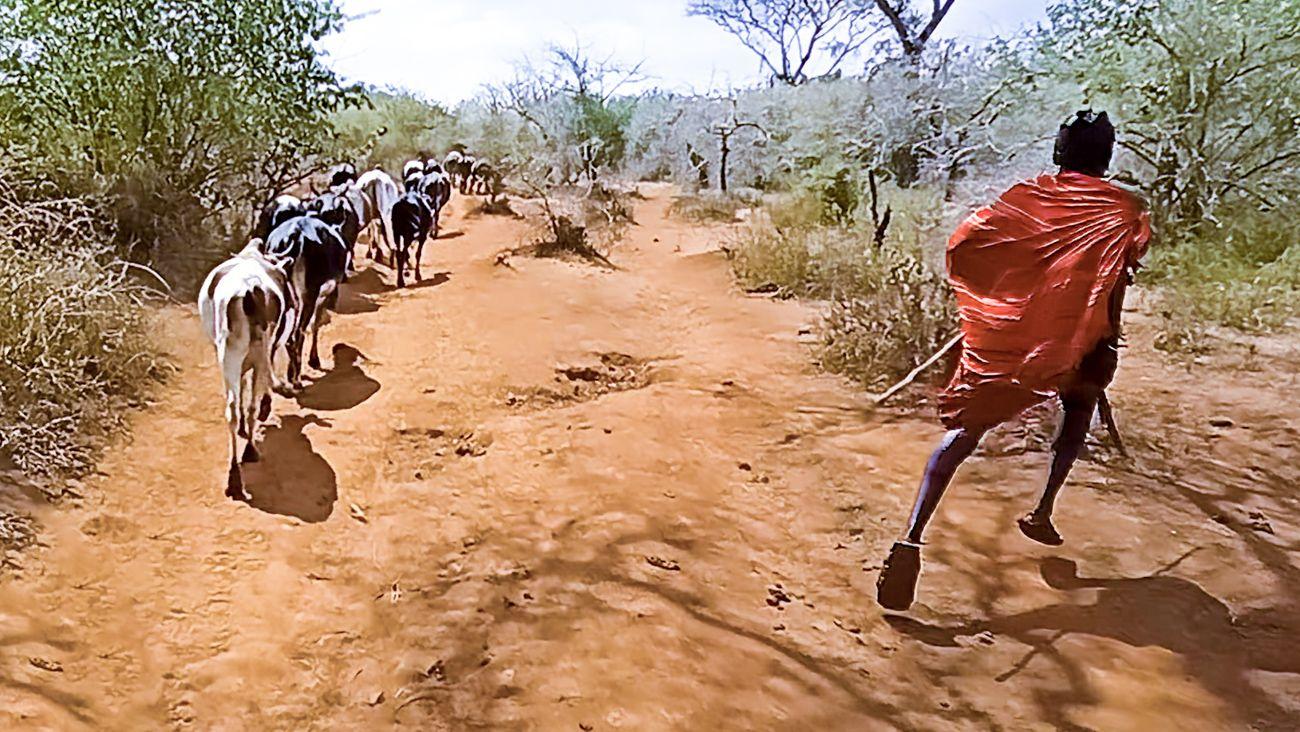
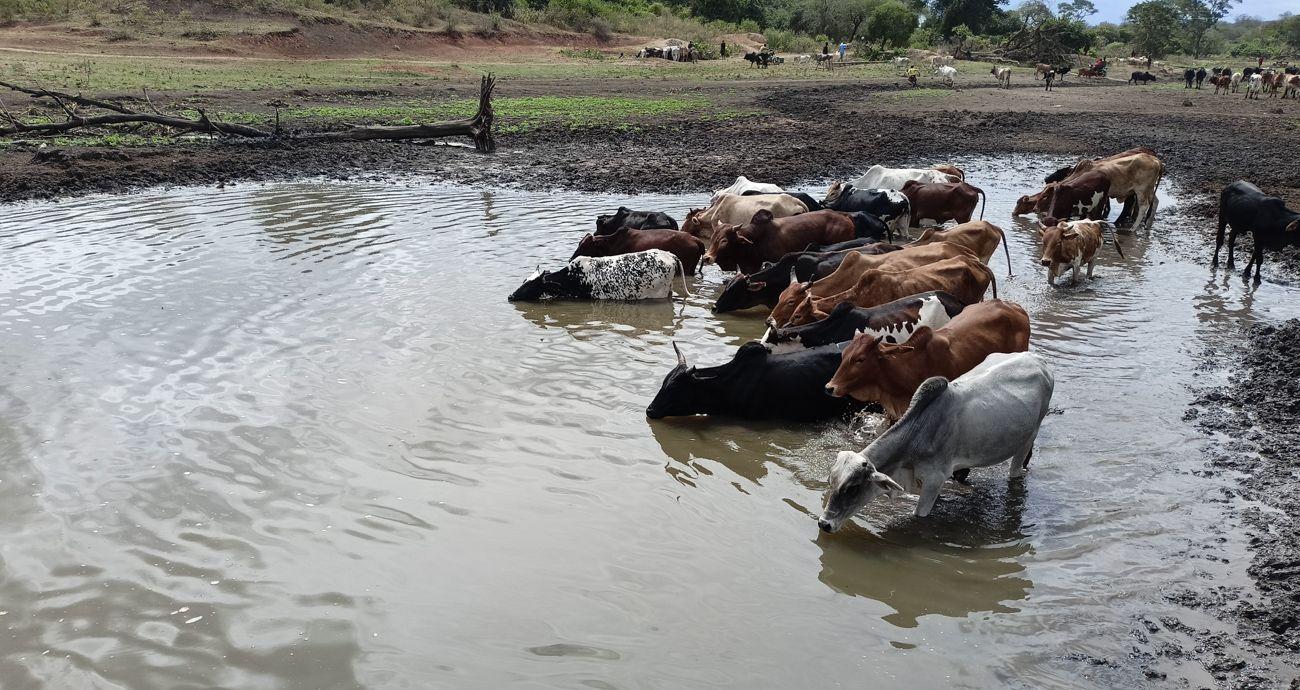
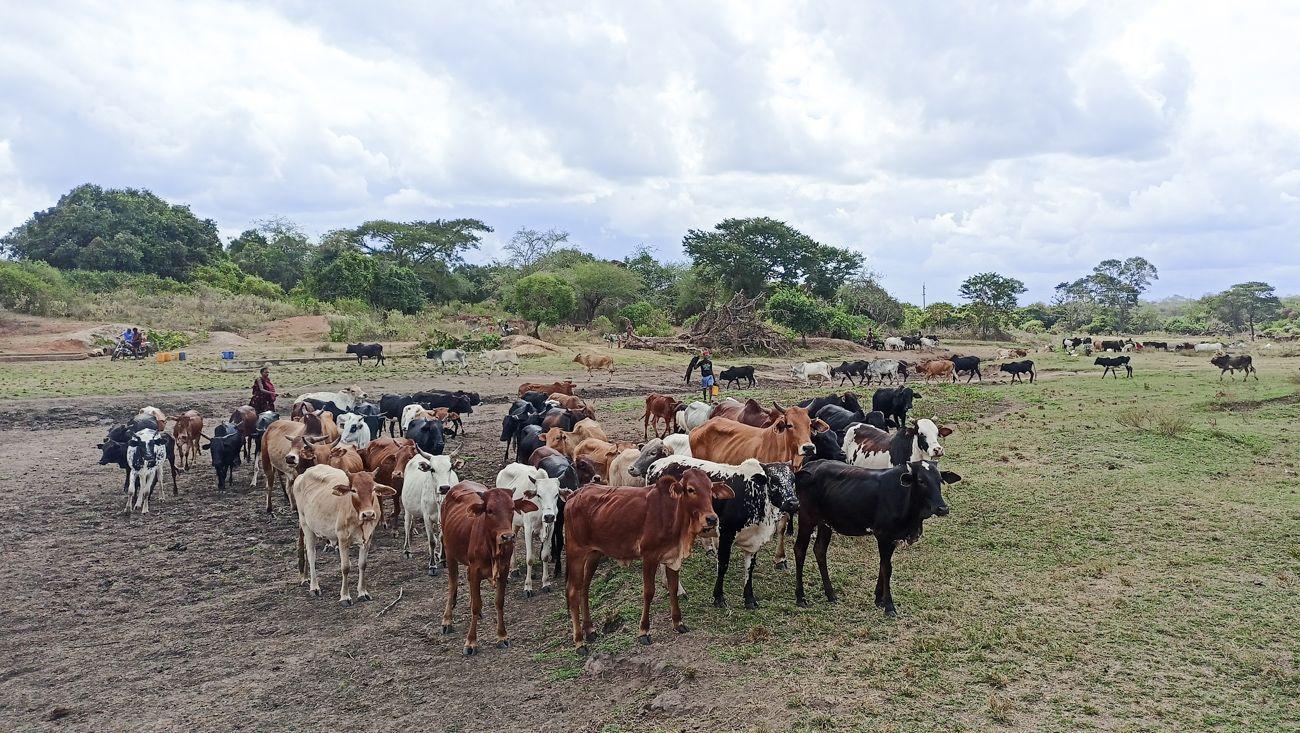
The Lengusero region has always faced severe water problems. In summer, heavy rains wash away roads, a few people drown, and by the end of winter, the drought becomes so harsh that the Maasai have to move their cattle closer to water sources, or the livestock would die of thirst. Someone once tried drilling a well there. But at 100 meters deep, the water was so heavily mineralized it was undrinkable.The only effective solution appeared to be building a dam. About five to six kilometers from the village where I stayed, there’s a watering hole called Bondeni. However, by the end of winter, it completely dries up. Building a dam there would solve the issue. The goal was clear—build the dam. Renča even contributed a significant sum toward it. Unfortunately, the execution went exactly as you might expect in Africa, filled with experts and practical solutions.
Once Mayor Munikiti had raised sufficient funds and deemed it time to construct the dam, he traveled to Handeni, the closest major city.There, he found a man who had both a bulldozer and confidence. The man promised to build the dam. Aside from a few amusing incidents—like how the bulldozer broke down more often than it worked, and the operator’s motorcycle was in equally bad shape—everything proceeded as expected. The bold builder designed, calculated, measured, and constructed the dam himself. He simply brought the bulldozer and piled up a 5-to-7-meter-high earth embankment to block a small valley. Great celebration! They would have water! It’s a shame Tanzania didn’t declare the day a national holiday. But soon, a small problem arose. Two weeks later, a major flood came and broke through the dam. Since then, it’s been back to the usual routine—drawing water from deep pits with buckets for the cattle. And when the water runs out, the cows migrate to wherever the water is.
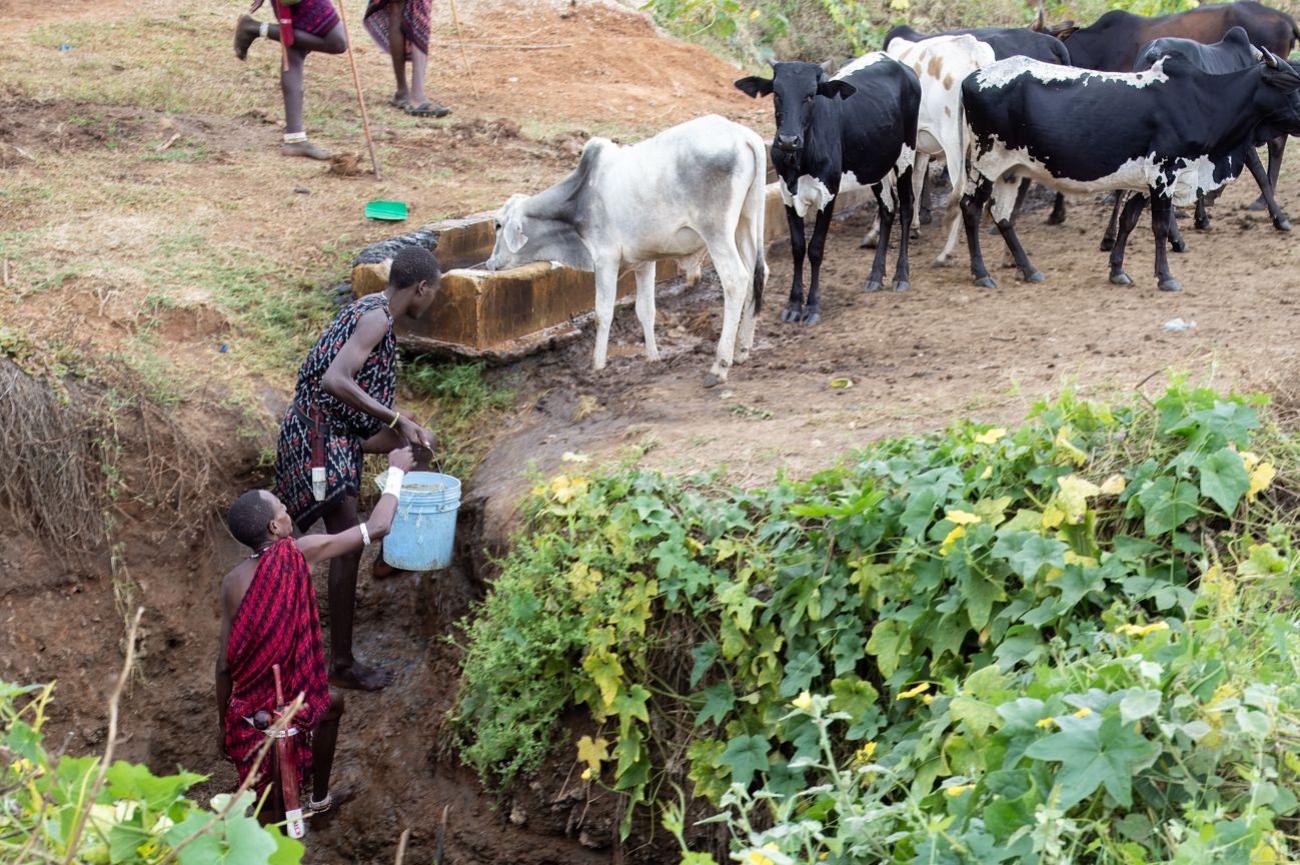
When I was there, of course, I wanted to try what the Maasai do all day—herding cows. Be a Maasai, breathe like a Maasai, eat like a Maasai, sing like a Maasai, herd cows like a Maasai. If I say "Maasai" one more time, I’ll definitely put a period there. Maasai. It all started innocently enough. Sekenoi said, “We’re taking the cows to Bondeni to drink. Come with us.” I thought, why not? I was feeling a bit thirsty myself. So, off to Bondeni we went. Naturally, on a motorcycle. There, we waited for a little while—about an hour in one spot, then twenty minutes in another—until the cows arrived. Buckets were used to pour water into a makeshift trough. The cows drank their fill. Suddenly, Sekenoi said to me, “Jano, GO COWS.” I’m Jano; cows are, well, cows. Like coffee to go. Cows to go. And with a cheerful heart, eager to finally herd cows, I thought, “GO COWS!”. But then, a minor, inconspicuous, barely noticeable flaw found its way into the plan.
The cows headed home by a different route than Sekenoi had expected. So, I got a little lost. Unaware of this, I happily strolled along a wide, dusty red clay road, observing the cows’ rear ends and enjoying their calming effect. It’s truly amazing—there’s something about the sight of swaying cow rumps that clears your mind completely. Your thoughts calm down, you come to terms with fate, time, the world, and the universe itself.

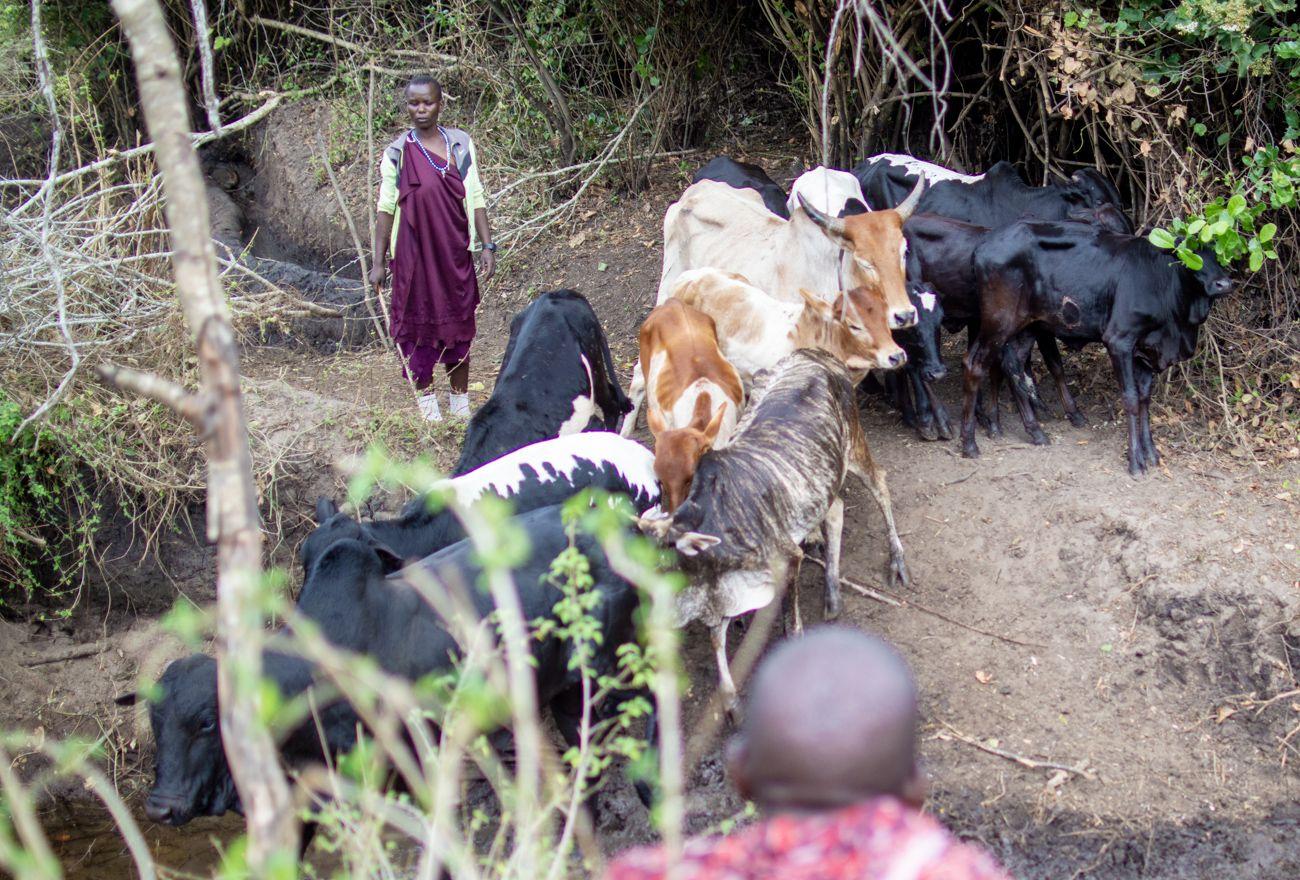
As I returned to my challenging journey in the company of cow backsides, I couldn’t help but notice the beautiful, slightly taller trees near the watering hole. They thrived thanks to the abundance of water, yet the area was also packed with bushes, much like the rest of the bushland. The beginning of this journey was definitely the most amusing, as numerous paths, wide and well-trodden by cows heading to the watering hole, seemed easily navigable. At least to the Maasai, who passed through without a second thought. Unlike me.
A small bush branch crossing the path was all it took—sharp hooks lay in wait, ready to ruin your day and delay you as much as possible. Trying to move a branch of acacia out of the way seemed simple enough. But it demanded careful examination—what exactly was sticking out onto the path, what type of prickly menace awaited you, and how could you safely remove it? Once you concluded the branch was harmless and pushed it aside with a light heart, another branch—lurking to the left or right—would be ready with jagged hooks to snag your shirt, yank off your hat, and stop you in your tracks. Perhaps those bushes liked me tIt took me roughly 20 to 30 minutes to cover that 50-meter stretch.
In the bush, paths that appear 10 meters long can, in reality, feel endless. After passing one, you might find yourself just 15 meters ahead. Often, you double back because the path becomes impassable, opting for a different, seemingly shorter 5-meter trail, which, of course, ends up being 30 meters long. Looks can be deceiving—whether it’s the bush or politicians. The bushes with their backward-facing hooks worked tirelessly to strip me of my clothes. I tried explaining that I wasn’t a stripper, and even if I were, they wouldn’t gain anything from it—because this interspecies striptease simply doesn’t work.
I picked my cap off the ground about 300 times, but that’s fine. The worst is behind me, and I’m moving on. As I stroll along, it’s neither too hot nor too cold, I’ve got everything I need in my backpack, and the world feels beautiful. From a distance, I suddenly hear someone shout, “We!” In Maasai, this translates to “Hey!” or “You there!” or… well, I’m not sure. Even on the phone, they just greet you with a simple “We!”.
At first, I ignored it. There were plenty of people at the watering hole, and I wasn’t about to let every random “hey-you-there” distract me. But curiosity got the better of me. I turned around and saw Sisoine, Sekenoi’s younger brother, waving at me from afar. I stopped, and his horizontal, side-to-side waving quickly changed to vertical, up-and-down waving, which in Maasai sign language means “Come here.” So, I abandoned my “Go cows” mission and walked over to Sisoine.

Not knowing any English, he grins broadly, gestures behind him toward Bondeni, and cheerfully repeats, “Sekenoi, Sekenoi!” Why is he telling me this? I know exactly who Sekenoi is. I see him every day and talk to him regularly. It only took me five days after we first met to remember his name. After about five minutes of this nonsensical back-and-forth, I finally understood that Sekenoi was there, and I was supposed to go to him. So, “Go cows” ended, and I switched to “Go Sekenoi.” Sekenoi, ever the action hero, was sitting on a motorcycle in Bondeni and had sent his brother on foot to find out where I’d wandered off to.
We got home safely, and later that evening over beers, as we dissected my little adventure, I confessed that I actually quite enjoyed being lost. I’m one of those adventurous lost types. As it turned out later, this was, indeed, a truly tactical mistake.
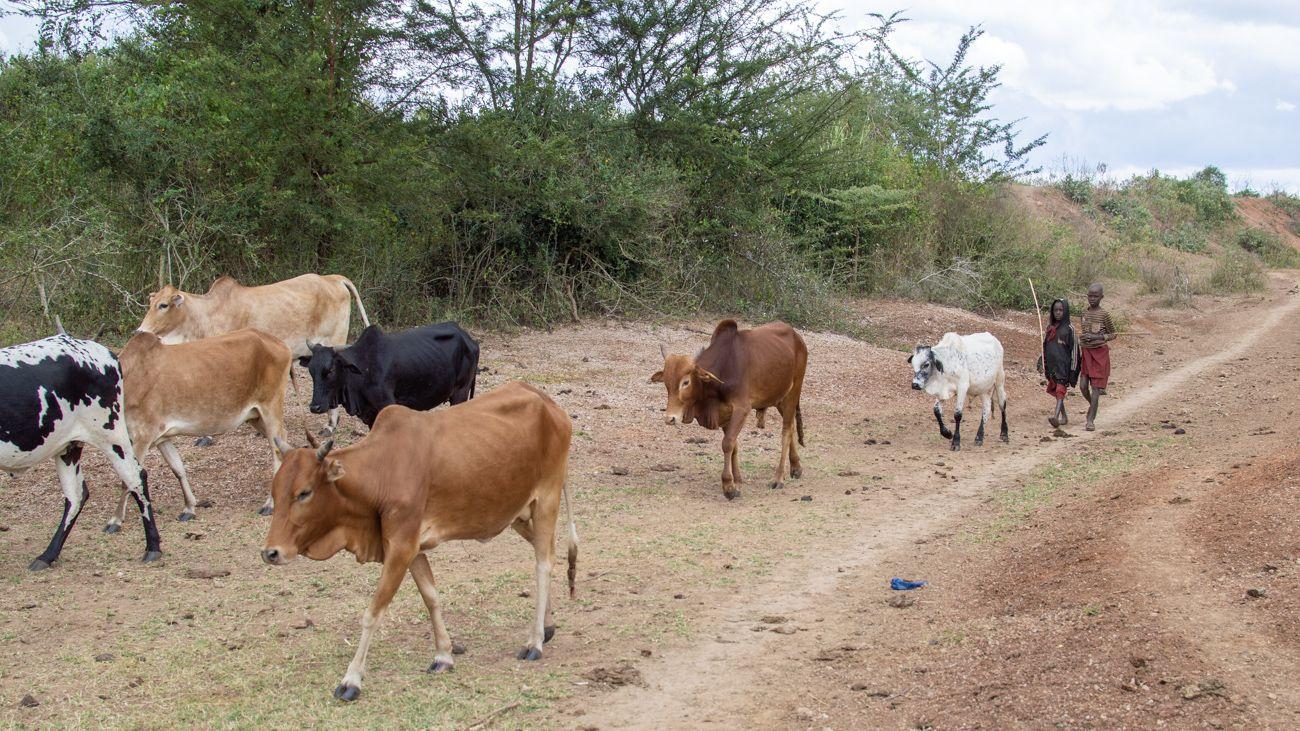
When I first tried "Go cows," I was captivated by the peace—the endless time to marvel at cow backsides. It was so divine that I decided to film a slow TV-style video, at least 40 minutes long, to share that heavenly experience with you. So, we set off for Bondeni again, and Sekenoi assigned Sisoine to accompany me. Sekenoi is just that type—always busy, always doing something, never stopping. Armed with a tripod I planned to use as a stabilizer, a fully charged phone battery, and a cheerful outlook, we embarked on our slow-Maasai TV project. With a gesture toward Sisoine, Sekenoi gave the order: “GO cows!” I immediately understood that I was supposed to go with Sisoine and then follow the cows, which had wandered off into the bush about ten minutes earlier.
I assumed Sisoine would guide me through the bush, clearing away any obstructing branches. Wrong. Apparently, someone let it slip that I enjoyed getting lost the last time, and they told Sisoine to let me wander solo in the bush again. Guess who spilled the beans? Whoever figures it out gets a reward—I’ll stare at them intently for 10 minutes. So, Sisoine disappeared into the bush, leaving me alone.
Plus, I was carrying a tripod about a meter and a half long and a camera, which left me with only one hand to deal with branches.The outcome was that the first stretch of herding cows was nothing but me huffing, stumbling, wrestling with thorny bushes, and spreading a dry cough to anyone or anything nearby.
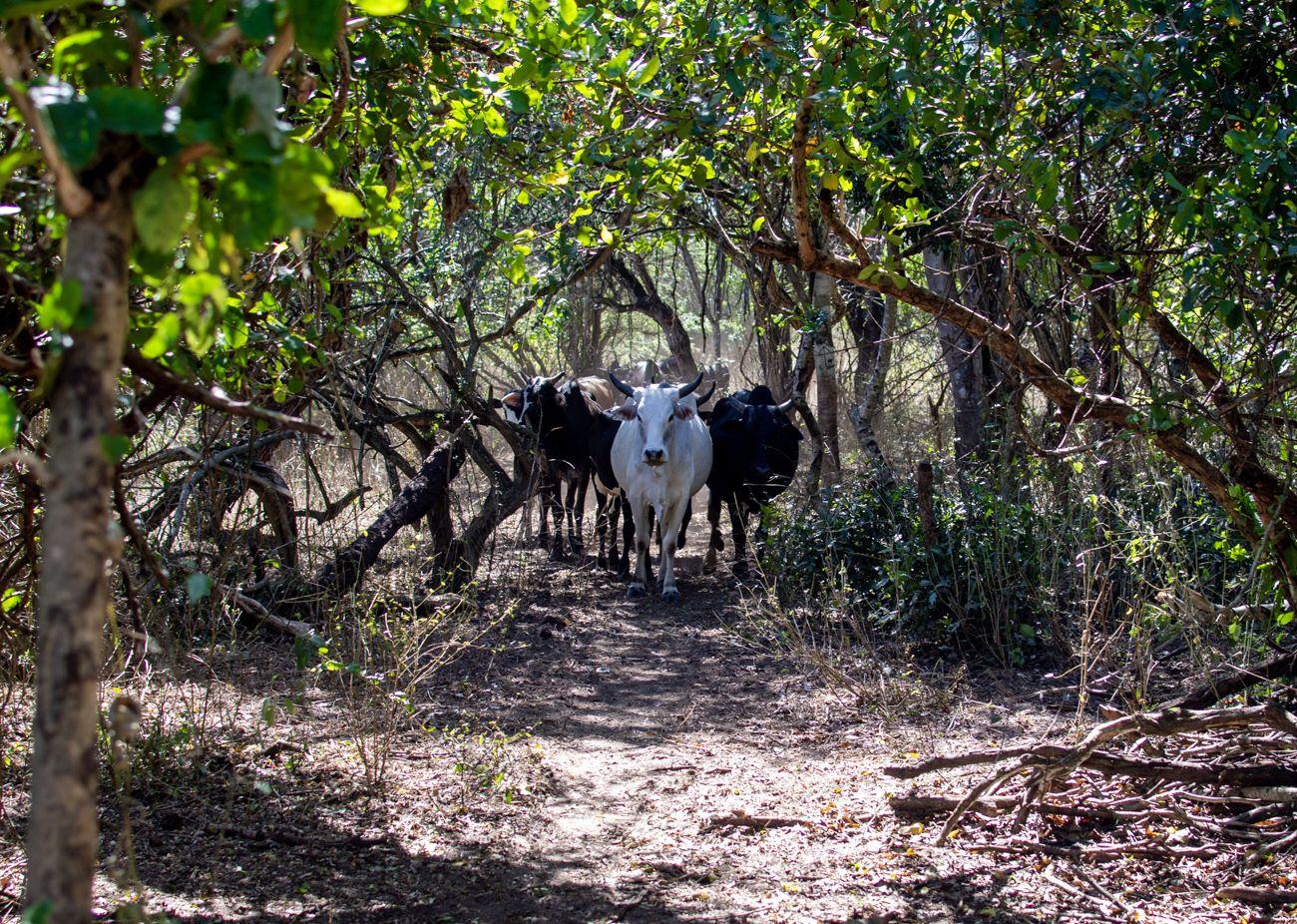
After a while, my cow-herding colleagues took pity on me. From about 30 meters away, I heard a shout: “We!” Which roughly translates to: “Hey you, mzungu, stuck in the bushes! Don’t worry, we’re here, come to us.” I’m not sure how you’d detect a cynical tone in the word “We!”, but I’m convinced it was there.
In these conditions, a 30-meter direct line is more like 130 meters for a bushman like me. Endless attempts to push through thorny hooks and creeping branches hanging across the path, doubling back, and starting the fight all over again. There were times when “We!” echoed not just ahead of me but also behind me. It felt like I was surrounded, but it turned out I’d just turned my back on them for a moment. As an eternal optimist, I was convinced my suffering would never end. The bush was a vast prison, and I’d wander through it even after death.
But since unbelievable things happen in this world, I eventually spotted a flash of Maasai red clothing through the bushes. Moments later, I saw the glint of enormous white teeth, which, I swear, were bigger than their heads.Sekenoi was laughing, probably at me—an old mzungu stumbling out of the bush, torn to shreds, yet oddly cheerful, as if drunk. The end of my wandering. Go cows. We spent the next quarter of an hour admiring the majestic rhythm of the cows’ rear ends swaying ahead of us. I had no idea where they were going, but honestly, I didn’t care. All the prickly and thorny nuisances were at a safe distance now. Never would I have guessed that swaying cow backsides under the African sun could have such hypnotic effects.
Here’s the revised translation with appropriate variants: Of course, Sekenoi had already told Sisoine to stay out of the camera shot and not to talk to me while I was filming. My goal was to create one continuous, uninterrupted 40-minute take. Since I also wasn’t supposed to speak to avoid ruining the shot, how could I tell a Maasai, standing 30 meters away, that it was perfectly fine for him to whistle at the cows, say something to me, and even appear in the shot—while I held a tripod with a camera in one hand and had only the other hand free? I waved my hand up and down until I managed to distract him. He forgot he wasn’t supposed to whistle or appear in the shot and slowly, hesitantly, emerged in the frame, running a step ahead.
When it comes to cows, Maasai skip conversations entirely and rely on an intricate system of whistles. They have about 1,451 different types of whistles, none of which I’ve understood to this day. Maybe if I spent 100 years there, I’d learn. The cows gradually wandered off the wide, red-sand-covered road and disappeared into the bushes at the edge. And just like that, I was back where I started—thorns, hooks, panting.
Sisoine alternated between whistling joyfully while standing still and sprinting to catch a wayward cow. Sisoine occasionally stood still, whistling cheerfully. Sometimes he ran when a cow went astray, moving with his trademark comic-book style: bent forward at a right angle, incredibly fast, and almost impossible to spot. At last, I understood why the cows were relatively small and produced so little milk. They grazed on bushes with maybe twenty half-dried leaves hanging on them. But about 10 meters away, I heard the sound of a motorcycle stopping. Sekenoi. I headed in that direction, and after a few minutes, I reached him. We were heading home. I think the cows gave me sad looks from the dense bushes behind, knowing they’d probably never experience another Jano Go Cows like this again.



Engarre is an officially registered civic association (Company ID: 54 373 549) based at Brodská 416/5, 841 04 Bratislava, Slovakia. Privacy Policy.