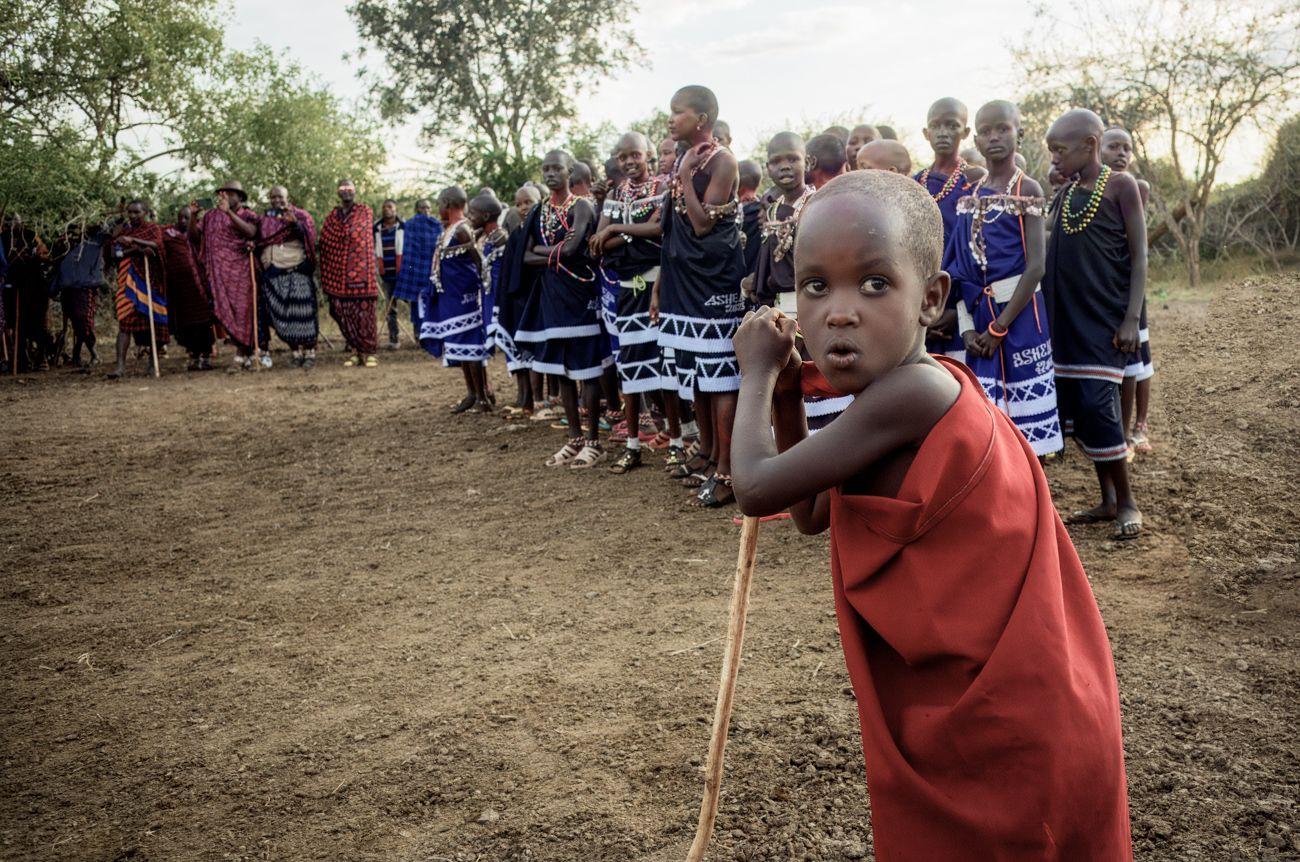
What happened next ranks among my most powerful experiences in all of Africa. Being part of a big Maasai celebration, one where we were just two mzungu—white folks—yet it was crystal clear the whole thing wasn’t staged for tourists. It was for us.
Sikuku show
So after the ceremonial celebrations, we headed back home for a bit of rest. After prolonged observation of the locals, I honestly couldn’t tell where work ended and relaxation began. Maybe if I spent a couple more years doing some serious ethnographic snooping, I’d start spotting subtle differences between those two states. But for now, I was still a sana mzungu—very white and very clueless. A few hours later, around ten-ish, Sekenoi barked: “Let’s go to the show.” Now this was something I hadn’t seen before. And just thirty minutes after the first command, we were already perched on a motorbike, speeding off to who-knows-where. A full-blown Maasai mobilization in under half an hour. It’s official: I’m signing Sekenoi up for Formula 1.
Riding through the night bush, the three of us squeezed onto a motorbike, turned out to be way more pleasant than our earlier lunchtime crawl to the ceremony. We didn’t crash into every shrub along the road this time, which was a nice change. When we arrived, it was pitch black. The only light came from the stars and maybe five solar-powered bulbs. The bulbs shone with the same blinding power as the stars—which is to say, not at all. Honestly, they could’ve saved themselves the trouble.
The boma was roaring with noise—everyone was chanting their minimalist Maasai melodies, and the place sounded like Mordor on karaoke night. My first thought? Everyone's probably thrilled the two mzungu have shown up. You know, fresh meat. Whether they were happy or not, I’m not sure. But they didn’t eat me. At least, I think they didn’t.
Because the roar of hundreds of voices was coming from all directions, I sensed the people before I saw them. Most of them were warriors, though there were a few elders sprinkled among them. They stood in a circle and sang. There were about a hundred of them in that one ring. Still treading carefully—just in case I accidentally became part of the Maasai food chain—I edged closer and peeked inside. Right in the middle, two warriors were taking turns leaping straight up, clearly trying to outjump each other.
As I later gathered, there was someone inside the circle acting as the unofficial judge, occasionally deciding who had jumped higher. But often, the audience made the call—cheering, stomping, or jumping into the circle themselves, all while the singing kept on. And that was just the opening act. There were still two more circles, each about the same size, because one simply wasn’t big enough for everyone.
If I understood the structure of these singing circles correctly, it worked like this: people stood in a circle and sang. Behold the genius at work. Inside the circle, young girls would sometimes dance, adult women sang and swayed, or two warriors would square off in a vertical showdown. Meanwhile, someone was always zipping through the ring, parodying the dancers with ridiculous flair. It was chaos. A light, entertaining kind of chaos. But later, it turned out the lead singer-slash-organizer-slash-ringmaster had things firmly under control. He decided which song would be sung next. And if the circle got too tight, he’d stop the show, whack the crowd apart with a stick, and carry on like nothing happened.
There weren’t always just three circles, though. Occasionally, a rebel faction—clearly unimpressed by the ringmaster’s playlist—would break away, form their own mini-circle, and launch into a fresh round of singing. Though honestly, it always sounded like the same song to me. People from the old, tired circle usually joined the rebels, caught a second wind, and kept singing, dancing, cheering, and hopping around like the night was still young.

After a while, though, the hypnotic chanting—endlessly repeating the same melody and the same words—and all that zigzagging between circles started to wear me down a bit. I’d finally gotten my bearings and spotted Alojz sitting on a parked motorbike. Being a proper Slovak, I hadn’t come empty-handed—I’d brought a little something from home. Unsurprisingly, I was very warmly welcomed. Still, I didn’t notice anyone at the celebration who seemed drunk or high on anything else. A few characters looked a bit... questionable, but nothing major. Apparently, instead of drugs, they manage to hypnotize themselves with hours of minimalist singing.
When I joined Alojz and sat down, I realized I had a flock of about fifteen kids trailing me. My first thought? “Kids are always the hungriest. This is it. The end.” But nope—they didn’t eat me either. Maybe it was because I was white, and in that darkness, I stood out like a flashlight at a rave. They followed me like I was the light. But the light had a few shots, shooed the kids away, and the evening suddenly became a whole lot more pleasant. Late dinner postponed.